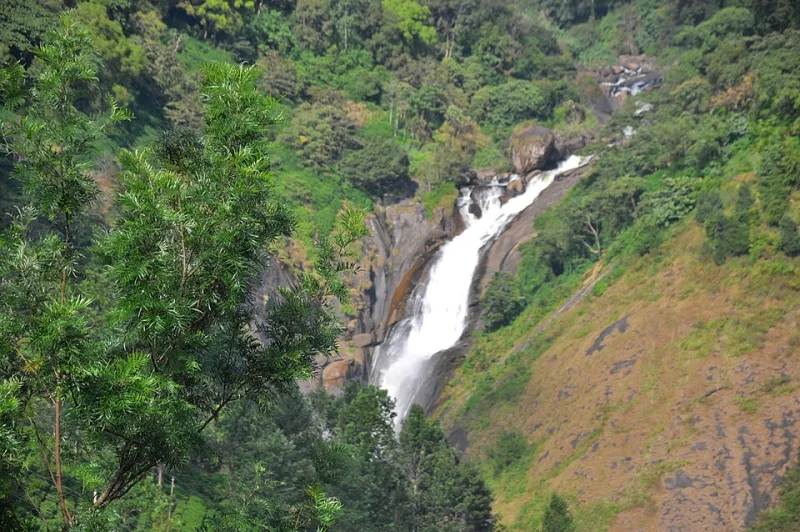
A steep rocky cascade beside the road at Chinnakanal, named after an old power house nearby, with wide views of tea country.
At a glance
What: A waterfall over a high rock face beside a hill road.
Where: Chinnakanal village, Idukki district.
When: Fullest in the weeks after the monsoon.
How: By road from Munnar by way of Devikulam.
By whom: A natural site on the tourist route; no major management recorded.
For whom: Road travellers, photographers and those visiting the Anayirankal side.
The waterfall
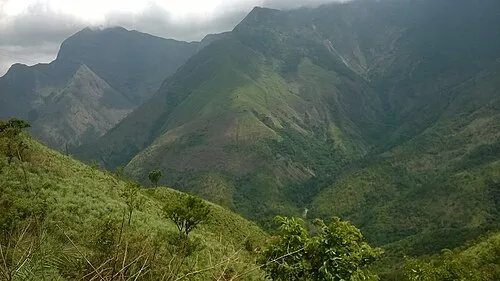
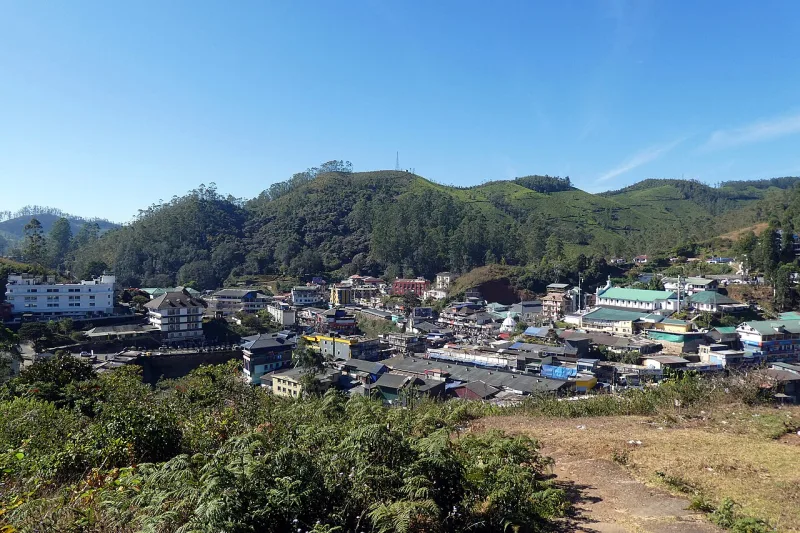
At Chinnakanal the stream comes down a steep face of rock in a long white descent, with tea slopes and the folds of the Western Ghats behind. The state tourism department places it at a high elevation, about two thousand metres above sea level by its account, and mentions a small pool at the bottom. The broad view over the valley is as much a reason to stop as the fall itself. Estimates of distance from Munnar run from fifteen to eighteen kilometres.
Why Power House
The name is plain and modern. An old powerhouse structure stood near the fall, and the cascade came to be called after it. Locally it is also known simply as the Chinnakanal waterfall, after the village. Chinna means small in Tamil, a reflection of the mixed speech of these plantation hills.
The water and its source
Tourism writing says the stream originates from Sita Devi Lake at Devikulam. Devikulam means the pond of the goddess, and belief holds that Sita bathed there during the exile described in the Ramayana. On the strength of that association the water is said to have healing qualities, and visitors speak of feeling refreshed. Refreshment is easy to confirm; healing is a matter of faith. Another travel source describes the stream simply as flowing from the Devikulam hills.
Chinnakanal
The village covers a wide area, about 67 square kilometres, and had around twelve thousand people at the 2011 census. It lies in tea, cardamom and forest country. In recent years it became known across India for Arikomban, a wild elephant famous for raiding stores in search of rice, whose story led to court proceedings and his relocation. That episode is a reminder that people and elephants share these slopes, often uneasily.
Getting there
Leave Munnar on the road towards Thekkady, pass Devikulam and continue to Chinnakanal; one description places the fall about a kilometre off the highway. Buses on the route can drop passengers, and taxis from Munnar frequently include the stop. The nearest large railway stations are at Aluva or Theni side towns, and airports at Kochi and Madurai.
Time on the spot
Entry is reported to be free, and one guide lists it as open at all hours, which simply reflects an unfenced site. Half an hour to an hour is typical. It is possible, according to travel notes, to trek down to the base. Only attempt this on a dry day, with good shoes and someone who knows the path.
Devikulam Lake nearby
The lake associated with Sita is about two kilometres from the falls and is often visited together with them. It lies among wooded slopes, and access may depend on estate or forest rules, which should be checked. Devikulam itself, about eight kilometres from Munnar and some 1,800 metres up, is a small and cool hill station with administrative offices.
Plants and scenery
Flowering shrubs, medicinal herbs and aromatic plants are noted around the falls. Tea covers the gentler slopes in clipped rows, broken by silver oaks. In the early morning the valley may be filled with cloud, which clears to show ridge after ridge. Photography is rewarding in that first hour.
Seasons
During the June to August monsoon the fall is powerful and the weather often thick. September to December brings strong yet manageable water and better visibility. January and February are cold, clear and drier. From March to May the flow may be small, although the cool air is welcome to travellers from the plains.
History
Beyond the vanished powerhouse and the plantation economy, no detailed history of the site was located. Electricity generation and tea were the two forces that brought roads into many such valleys, and the fall's name preserves a memory of the first.
Rumours
It is repeated that the water cures illness and stress. A quiet hour in the hills may well ease the mind, but do not rely on stream water for health, and do not drink it without treatment. Some also claim elephants never come near the road by day. They do, on occasion, and should be given a wide berth.
Safety
Stop only where vehicles can leave the carriageway. Look out for traffic on curves and in mist. Keep back from wet rock and never stand at the head of the drop. Do not approach, photograph closely or provoke elephants; stay in the vehicle or retreat quietly, and follow forest staff. In emergencies dial 112.
Respect for the valley
Take rubbish away, avoid horns and loud sound systems, and do not walk into tea fields. Buy from local stalls if you wish, and ask before taking portraits of workers.
Elephants and people
The Chinnakanal country is one of the better known places in Kerala for conflict between wild elephants and settlements. Houses, ration shops and fields stand on ground that elephants have long used. For a visitor the lesson is practical: drive slowly after dusk, do not stop to feed or tease any animal, and treat a warning from a resident as urgent. For anyone interested in conservation it is worth reflecting on how a landscape of tea, homes and forest fragments leaves little room for large animals to move.
Planning around the weather
Mist can fill the valley and empty it again within minutes. If the view is hidden on arrival, wait a little before giving up.
Nearby
Anayirankal dam with its tea fringed reservoir, Lockhart gap, the viewpoints above Devikulam and the Kolukkumalai side for sunrise are all in this direction. A day trip from Munnar can cover several if it starts early.
Questions visitors ask
Is swimming possible? A small pool is mentioned, but check depth and current first. Are there toilets? Do not count on them. Can it be seen from a vehicle? Yes, from the road side. Is it worth visiting in rain? The fall is grand then, but views may vanish in cloud.
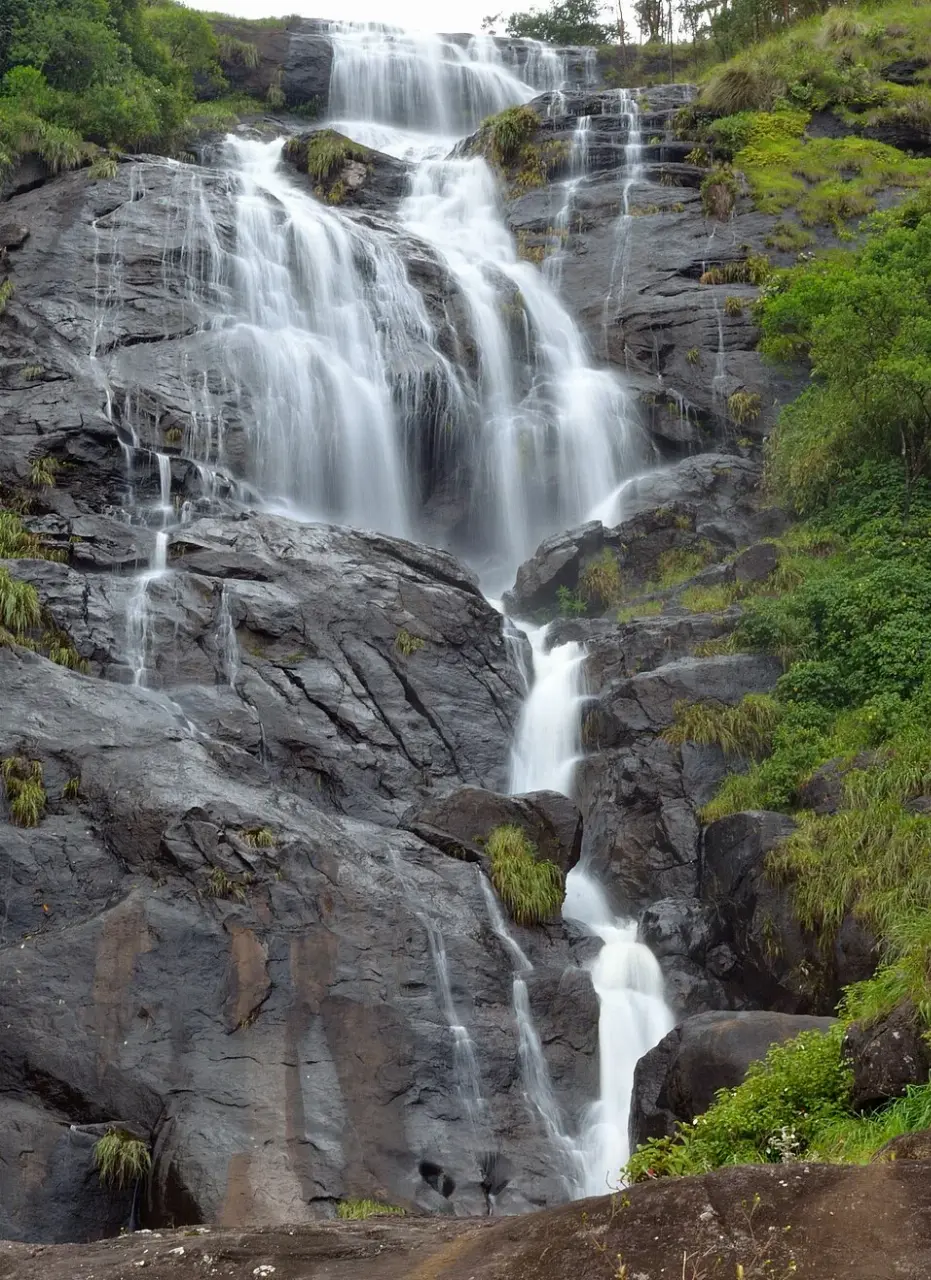 Photo: Darshanhr.007 · CC BY-SA 4.0