Rabindranath Tagore's university town near Bolpur, listed as a World Heritage Site in 2023 for its distinctive ideas of learning, art and architecture.
Santiniketan, the abode of peace, began as a retreat established in the nineteenth century by Debendranath Tagore, father of the poet. His son Rabindranath turned it into one of the most original experiments in education in modern times. He started a school in 1901 where children studied close to nature, often under trees, and later founded Visva-Bharati, a university intended to be a meeting place of Indian and world cultures.
UNESCO inscribed Santiniketan on the World Heritage List in September 2023. The recognition concerns the ensemble of buildings, open spaces and artworks that express Tagore's ideals, developed in a spirit that drew on Asian traditions and moved away from both colonial styles and a narrow modernism. Today it is a neighbourhood of Bolpur town and a living campus.
The oldest structures include Santiniketan Griha, the house from which the settlement grew, and the Upasana Griha, a prayer hall of coloured glass and open design built for worship without idols. The Uttarayan complex contains several houses in which Rabindranath lived, each with its own character, and the Rabindra Bhavan museum holds manuscripts, paintings, photographs and personal items. At Kala Bhavana, the art school, murals, sculptures and decorated walls by figures such as Nandalal Bose, Benode Behari Mukherjee and Ramkinkar Baij reward careful looking. Many works stand in the open, among the paths and trees.
Visitor access is regulated. Some parts of the campus are open only at certain hours, others are limited to students and staff, and rules for heritage areas, guided walks and photography have changed since the World Heritage listing. The university has its own weekly holiday, which differs from the usual pattern, and museum timings should be checked locally. Ask at the information points before setting out.
Walk or hire a rickshaw to explore. Move quietly near classes, do not touch artworks or enter buildings without permission and ask before photographing students or residents.
The surrounding countryside is part of the experience. The Khoai, a landscape of reddish soil carved into small gullies, hosts a popular weekly market on Saturdays, with handicrafts and Baul singers whose mystical songs inspired Tagore himself. Craft villages produce leather work with painted designs, kantha embroidery, batik and pottery, and Sriniketan nearby was founded by Tagore for rural reconstruction. Buying directly from makers helps the local economy.
Festivals draw large crowds. The Poush Mela in late December and the spring celebration around Holi have been the best known, although venues, dates and public admission have varied in recent years, so confirm the arrangements. Book accommodation early if travelling at these times. Resorts and guest houses range from simple to comfortable.
Other excursions include the Kankalitala shrine, the temple town of Tarapith and the terracotta temples at Surul and further afield in Birbhum. The Ballabhpur wildlife area shelters deer and, in winter, birds.
November to February is delightful, with mild days and cool evenings. Summer is very hot, and the monsoon turns the red earth and green fields vivid but muddy. Give Santiniketan at least a full day and night. Its importance reveals itself gradually, in a mural noticed on a wall, a song heard across a field, or the sight of a class gathered beneath a tree, still carrying forward a poet's belief that learning should be joyful and open to the world.
Cycle rickshaw drivers know the lanes well and many offer a short tour; agree the places and the price first. Leave time to sit with a cup of tea near the campus and simply listen, which is perhaps the closest a passing visitor can come to the unhurried mood Tagore hoped to create.
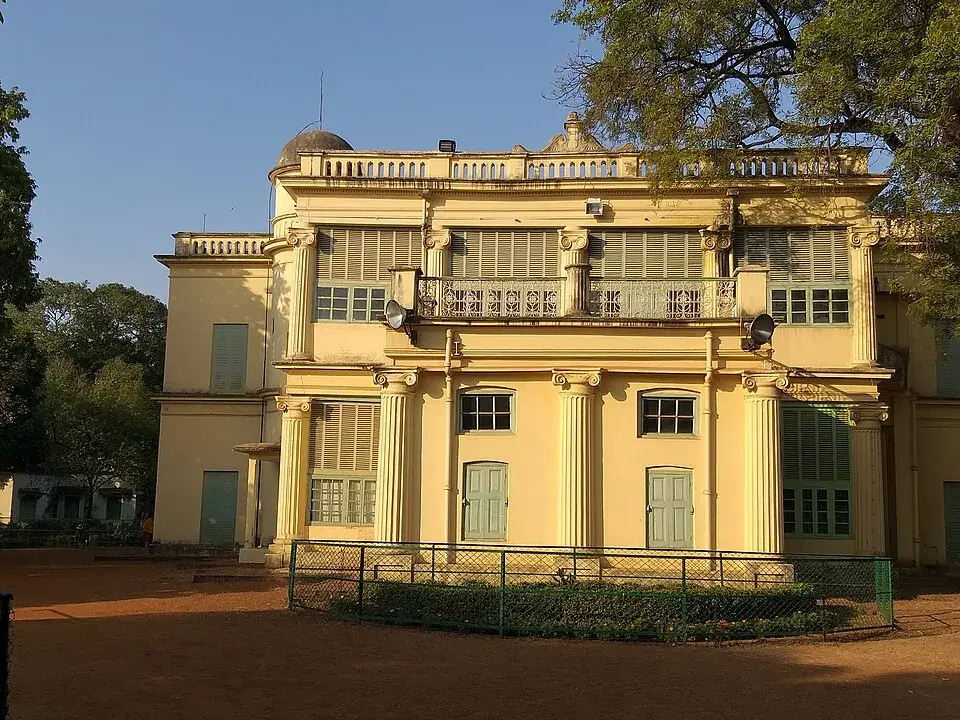 Photo: Billjones94 · CC BY-SA 4.0