The royal burial mounds of the Ahom dynasty in eastern Assam, listed by UNESCO as a World Heritage Site in 2024.
On low wooded hills in eastern Assam, rows of grassy domes mark the resting places of kings and queens. These are the moidams of Charaideo, the burial mounds of the Ahom dynasty, which UNESCO inscribed on the World Heritage List in July 2024. It was the first cultural World Heritage property from the Northeast of India.
Charaideo holds a special place in Ahom history. By tradition it was established in 1253 by Sukaphaa, the first Ahom king, who had crossed the hills from the east and founded a realm that would endure for about six hundred years. The name is often explained as the shining city on the hills. Although the political capital later moved several times, Charaideo remained the symbolic and sacred centre, and members of the royal family continued to be brought here after death.
A moidam typically consists of a vaulted chamber, built in earlier times of timber and later of brick and stone, covered by a mound of earth. On top there may be a small shrine or pavilion, and around the base a low boundary wall, often with eight sides, reflecting Ahom ideas about the universe. The dead were buried with objects intended for use in the next life. Many tombs were disturbed over the centuries, including by treasure seekers, and the finds that survived help scholars understand the customs of the court.
What visitors see today is a landscape of striking calm. The mounds rise in different sizes among trees and trimmed grass, their curved outlines repeating across the hillside. The tradition is sometimes compared with royal burial landscapes elsewhere in Asia, but the character here is distinctly local, shaped by the Tai Ahom beliefs and the terrain of the Brahmaputra valley.
Walk slowly along the marked paths in the protected area. Begin with any interpretation centre or museum display that is open, since drawings of the chambers make the visit much clearer. A guide can explain the ritual of Me-Dam-Me-Phi, the Ahom ceremony honouring ancestors, which remains important to the community and is observed with special programmes in the early part of the year.
These are graves, and many people regard them with reverence. Do not climb or slide on the mounds, sit on shrines, remove stones or leave rubbish. Keep voices low, follow the instructions of guards and ask before photographing people performing rituals. Drones generally require permission.
Opening hours and entry fees are set by the authorities managing the site, and arrangements have been developing since the World Heritage listing, so confirm them locally. Wear comfortable shoes for uneven ground, carry water and protection against sun and rain, and use insect repellent in the warm months.
Charaideo fits naturally into a tour of the Ahom heartland. Sivasagar, less than an hour away, preserves the Rang Ghar, a two storey royal pavilion; the Talatal Ghar palace complex; the Kareng Ghar at Garhgaon; and temples beside large historic tanks, among them the Sivadol. Jorhat, with its tea estates and access to the river island of Majuli, is within reach, and the Statue of Valour honouring the general Lachit Borphukan stands near Teok.
Simple lodging is available in the district towns, while Sivasagar and Jorhat provide wider choices. Hiring a car for the day is the easiest way to link the monuments. October to March offers cool, dry weather and the clearest views; the monsoon makes the mounds intensely green but paths slippery.
Spend a little time sitting at a distance and looking across the field of domes. Without towers or ornate carving, the place conveys the long continuity of a dynasty through earth, grass and memory, and shows a side of India's royal history that travellers from outside Assam are only beginning to discover.
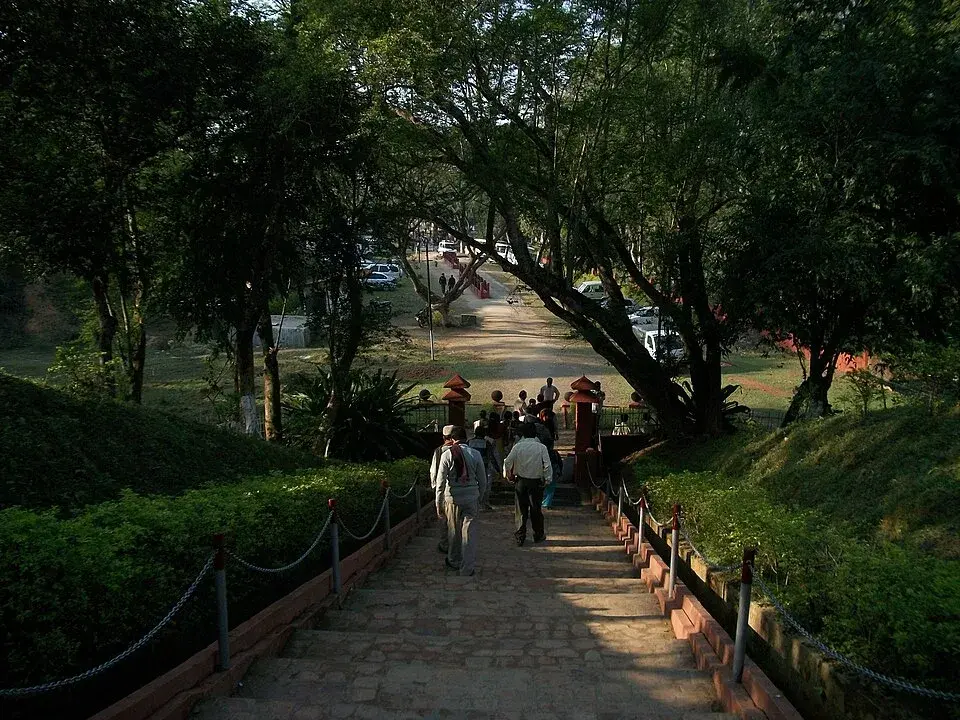 Photo: Zorodocknife · CC BY-SA 3.0