The state's science centre with hands on galleries and a planetarium, an easy and enjoyable stop for families in the city.
At a glance
What: A museum of science and technology with an attached planetarium.
Where: In central Thiruvananthapuram near PMG Junction.
When: Museum established in 1984; planetarium working since 1994.
How: Reach by city bus or autorickshaw.
By whom: An autonomous institution set up by the Government of Kerala.
For whom: Children, students, teachers, families and curious adults.
About the museum
Learning that the Earth spins is one thing; watching an apparent wheeling of the whole sky across a dome is another. The Kerala Science and Technology Museum was created to give people that second kind of learning. Its stated aim is to popularise science and cultivate a scientific temper among the public, especially the young. Galleries present principles and technologies through models and working exhibits, and the Priyadarsini Planetarium adds the sky.
Published accounts speak of about ten galleries with a few hundred items, though they give different totals. Subjects found in science centres of this kind include mechanics, electricity, electronics, transport, life sciences and popular mathematics; the current layout is best checked on arrival, since galleries are renewed from time to time.
History
The museum was established by the state government in 1984 as an autonomous body. Ten years later, in 1994, the planetarium attached to it began functioning. It belongs to a wider movement in independent India that saw science museums and planetaria as classrooms open to all. The phrase scientific temper, which Jawaharlal Nehru popularised and which the Constitution lists among the duties of citizens, captures the idea: asking for evidence, testing claims and being willing to change one's mind.
Inside a planetarium
A planetarium projects stars, planets and moving images onto a hemispherical ceiling. Seated in reclined chairs in darkness, the audience can see the night sky free of city glare, travel forward or backward in time and view the heavens from other latitudes. A typical programme points out constellations visible in the season, explains day and night, phases of the Moon or eclipses and then follows a theme such as the solar system. Kerala Tourism has listed shows in Malayalam and in English at different hours, together with a three dimensional show. Such timetables become outdated, so confirm before you go.
Kerala and the stars
The state has an old relationship with astronomy. Between the fourteenth and seventeenth centuries a line of mathematicians and astronomers now called the Kerala school, beginning with Madhava of Sangamagrama and including Parameshvara and Nilakantha, worked out infinite series for trigonometric quantities and refined planetary calculations, centuries before similar series became well known in Europe. Modern India's space programme began close by, at Thumba on the city's coast, where the first sounding rocket was launched in November 1963. A visit to the museum is a good occasion to tell children both stories.
Sky stories and facts
Cultures have explained the sky through tales. In Indian tradition eclipses were attributed to Rahu seizing the Sun or Moon, and the seven bright stars of the Great Bear are the seven sages. Planetarium programmes can show what actually happens: an eclipse is a matter of shadows, with the Moon passing between Earth and Sun or Earth casting its shadow on the Moon. Popular rumours that food spoils during eclipses or that harmful rays require special precautions are not supported by evidence. The genuine precaution concerns solar eclipses: never look at the Sun without proper certified filters.
Astrology, which claims to read destiny from planetary positions, is different from astronomy, the study of what celestial bodies are and how they move. The planetarium deals with astronomy.
Trying things for yourself
The best exhibits in a science centre invite a guess before the demonstration. Which of two balls will arrive first? Why does a spinning wheel resist being tilted? How can a mirror make an object appear where there is nothing? Say your prediction aloud, then operate the model gently according to instructions. Being wrong is not a failure here; it is the moment when curiosity starts. If an exhibit is out of order, tell a staff member and move on.
For teachers
A school visit works best with a short preparation lesson on one theme, a worksheet with a few open questions and time afterwards for pupils to share what surprised them. Ask in advance about group bookings, show timings in the pupils' language, lunch space, bus parking and accessibility. Linking exhibits to the syllabus helps, but leave room for wandering, since a child may discover an interest that no lesson plan predicted.
For families on a tight schedule
If time is short, choose the planetarium show first, since it runs to a timetable, and see galleries before or after it. Give the youngest member of the group the job of picking the next exhibit. A calm visit to a few displays teaches more than a rush past all of them, and a return trip in another season brings a different sky to the dome.
One more tip
Wear comfortable footwear, since seeing the galleries involves a good deal of standing.
Visiting
Buy tickets for the show you want soon after arriving, because seats are limited and school groups often book. Late entry into the dome is usually not allowed. Switch off phone screens inside. Food is generally excluded from galleries. Photography rules vary. Listings indicate that the planetarium is closed on Mondays; museum hours are given differently by different sources, so verify them on the official website or by telephone.
Allow two to three hours for one show and the galleries.
Questions visitors ask
What age is suitable? Older children benefit most; very small children may be frightened by darkness. Which language should we choose? Pick the show timed in the language the group understands best. Is it good in the monsoon? Yes, it is indoors.
Getting more from a visit
Choose three exhibits and ask each child to explain one in their own words afterwards. Look at the sky the same evening and find one planet or constellation that appeared on the dome. That small act connects the museum to real observation, which is its purpose.
Around the museum
The Napier Museum, zoo, art gallery, Kanakakkunnu Palace grounds, the legislature complex and the university library are all close, so a full day of learning can be planned within a compact area, with parks for rest between visits.
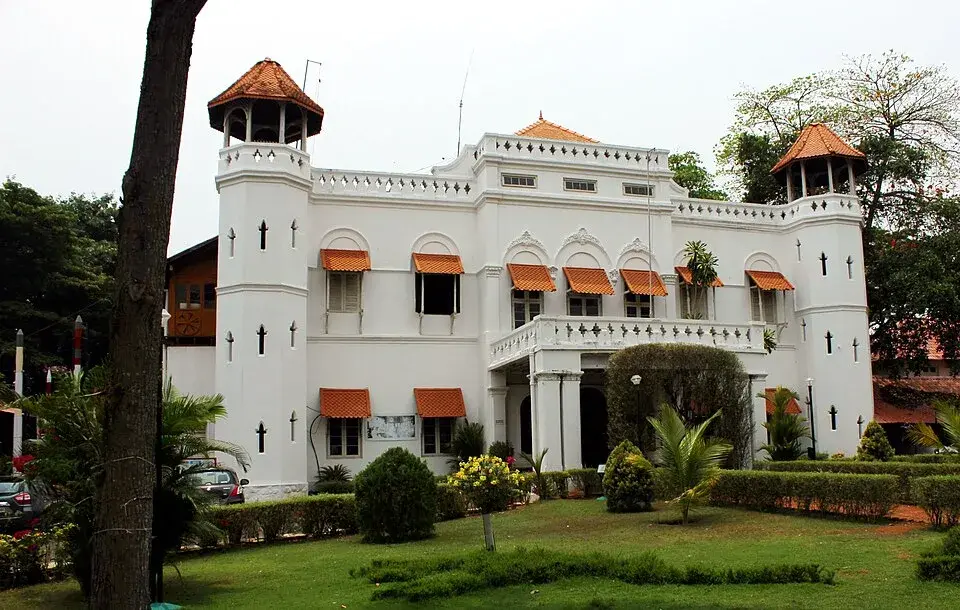 Photo: Sanu N · CC BY-SA 4.0