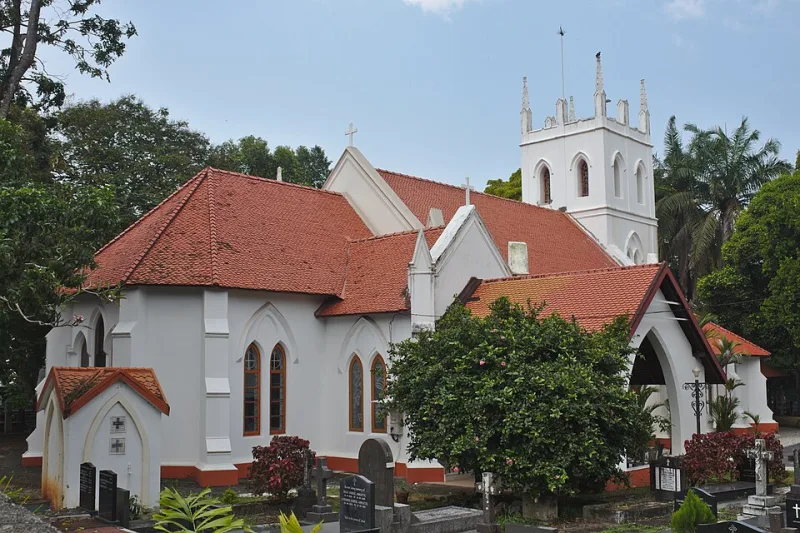
A granite hall church dedicated in 1906 in memory of the missionary Samuel Mateer, now a cathedral of the Church of South India.
At a glance
What: A Protestant cathedral built of granite in the hall church manner.
Where: LMS Junction, in central Thiruvananthapuram.
When: Dedicated on 1 December 1906.
How: Walk from Palayam or the museum, or take any city bus passing LMS.
By whom: Built by the London Missionary Society and its local congregation in memory of Rev. Samuel Mateer.
For whom: Worshippers, students of history and admirers of stone architecture.
About the cathedral
A solid grey building of granite stands near one of the busiest junctions of the capital, so familiar that the junction itself is called LMS after the missionary society that built it. The Mateer Memorial Church, now a cathedral of the Church of South India, is a hall church, a type in which the side aisles rise to about the same height as the central space, creating one broad room where a large congregation can see and hear. For a Protestant tradition that places preaching and congregational singing at the centre of worship, such a plan is well suited.
The stonework is the first thing to notice. Squared blocks, openings with arched heads and a sturdy outline give the building a seriousness quite different from the painted churches along the coast.
History
Protestants in Thiruvananthapuram first gathered in a church put up in the 1830s by the Protestant Evangelical Trust. In 1838 the Reverend John Cox arrived as the first missionary of the London Missionary Society stationed in the city, and the history of the present congregation is traced from that beginning.
The man remembered in the name, Samuel Mateer, was born near Boardmills in County Down in Ireland. He served in Travancore for about thirty three years and is regarded as a pioneer in making the church genuinely Indian. He trained local people for the ministry, saw a number of them ordained and tried to move administrative responsibility into their hands. When he arrived there were 25 congregations, about 3,000 Christians and an annual income of 800 rupees; by the time he retired the figures had grown to 56 congregations, 10,060 Christians and 3,000 rupees.
His wife returned to England in 1890 because of ill health, and Mateer followed on leave in 1891. He died at Hastings on 24 December 1893, with his five children beside him, and is buried there. The Trivandrum congregation became a pastorate, and the granite building, constructed as a memorial, was dedicated on 1 December 1906.
The writer missionary
Mateer left two books about the land where he worked, Native Life in Travancore and The Land of Charity. They record the customs, occupations, beliefs and social conditions of many communities, including the severe disabilities imposed on the lower castes and the enslaved. Historians still consult them. Like all such writing from the colonial age, they reflect the outlook and aims of the author, who was seeking support for his mission, and so reward critical reading alongside Indian sources.
Union into the Church of South India
The church predates two great unions. In 1908 several missions came together as the South India United Church. Then on 27 September 1947, weeks after Independence, the United Church joined with Anglican and Methodist bodies to form the Church of South India, a union watched with interest around the world because it combined churches with bishops and churches without them. The Mateer Memorial Church became part of the new body and later gained the status of a cathedral.
Stories and remembrance
Within mission memory, the stories told most often concern perseverance: preachers walking long distances between village chapels, schools opened for children who had no other chance to read, girls taught needlework and lace making, and families who endured social pressure for their faith. The society's work in southern Travancore is also associated with the period of agitation over the right of Nadar women to cover the upper body, a struggle of the nineteenth century in which converts and others asserted their dignity against caste rules. Accounts of that struggle differ in emphasis, and it deserves to be read about carefully.
Misunderstandings and facts
The initials LMS are sometimes taken to stand for a person or a modern company; they refer to the London Missionary Society, founded in 1795. Some assume the church was built by Mateer himself. It was raised after his death, to honour him, and completed in 1906. Others confuse it with the Catholic cathedral at Palayam nearby; the two belong to different traditions.
Worship today
Services are held on Sundays and on weekdays according to the cathedral timetable, in Malayalam and, at stated times, English. Singing is a strong feature. Christmas, with carols, stars and lit decorations, Good Friday, Easter and the harvest festival, when members bring produce and gifts in thanksgiving, are high points of the year.
Schools, books and print
Missions of the nineteenth century set great store by reading, since believers were expected to study the Bible for themselves. Village chapels often doubled as schoolrooms, and teachers were trained to staff them. Printing presses produced primers, hymn books and periodicals in Malayalam and Tamil, the two languages of the southern districts. The London Missionary Society's field in Travancore covered a largely Tamil region further south as well as the Malayalam speaking country around the capital, and the effects on literacy were felt well beyond church members. Government, temple related, Muslim, Catholic and community schools all contributed in time to the high literacy for which Kerala is known, so the mission's part is best seen as one strand among several.
Looking at the building
Stand across the road to take in the full outline, then move closer to see the dressing of individual granite blocks. Granite is hard to cut, and shaping it by hand for a large church required many months of skilled work by masons whose names are rarely recorded. The thick walls keep the interior comparatively cool.
Visiting
Come quietly and dressed modestly. If a service is in progress, join respectfully at the back or wait outside. Photography indoors needs permission. Keep the grounds clean and give way to worshippers entering and leaving. The junction is heavily used, so cross at marked places.
Half an hour is enough for the building and a quiet look inside when open.
Questions visitors ask
Can the interior always be seen? Doors may be closed between services, so ask at the office. Is there a charge? No entry fee should be expected. Are there memorials to read? Look for plaques and inscriptions, which are good clues to the people connected with the congregation, but do not wander into private or restricted spaces.
Around the cathedral
The Napier Museum, Sree Chitra art gallery and zoo, Kanakakkunnu Palace, St. Joseph's Cathedral, the Palayam Mosque and the public library are within walking distance, along with cafes and bookshops, making the area ideal for a leisurely day on foot.
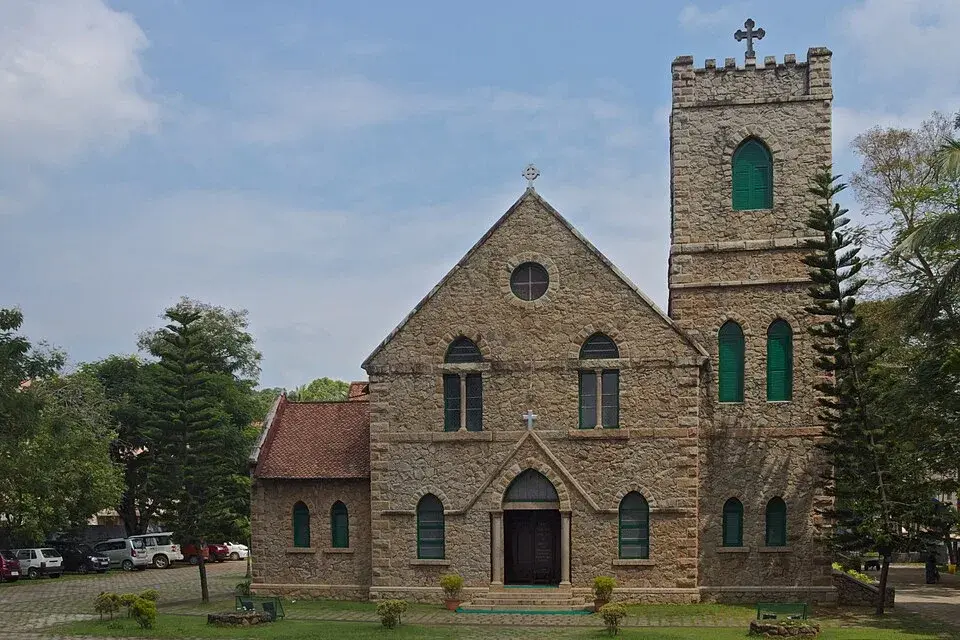 Photo: Shishirdasika · CC BY-SA 4.0