The capital's foremost mosque, begun as a soldiers' prayer place in 1813 and rebuilt in the 1960s, famed for harmony with its neighbours.
At a glance
What: The principal Friday mosque of Thiruvananthapuram, following the Hanafi Sunni tradition.
Where: Palayam, in the centre of the city.
When: First built in 1813; the present mosque was inaugurated in 1967.
How: Walk from the Palayam bus stops.
By whom: Founded by Muslim soldiers of regiments stationed here and rebuilt by community support under its first imam.
For whom: Worshippers, and respectful visitors interested in the city's shared history.
About the mosque
Few views express the character of Thiruvananthapuram as well as the one at Palayam, where a mosque, a Hindu temple of Ganapathi and a Catholic church stand close together. Citizens point to it with pride, and visitors often photograph the neighbouring towers and minarets in a single frame. The mosque, officially named Masjid-i Jahan Numa, a Persian phrase meaning the mosque that reflects the world, is the most important in the city. A madrasa for religious instruction operates in its grounds.
History
The beginning was military. In 1813 the Second Regiment of the British Indian army was stationed in the town, and its Muslim soldiers raised a small place of prayer with an open ground for the Eid congregations. People called it Pattalappalli, the soldiers' mosque. In 1824, when the Sixth Regiment was posted at Palayam, its officers bought land, appointed a qazi from the Labba family, whose line continued until Sheikh Mansoor Labba, and placed the documents of the mosque in the care of the muezzin.
In 1848 the junior officers of the Sixteenth Regiment, its jamadars and havildars, made considerable improvements, including a gate and arrangements for upkeep. Later regiments added their own changes. The mosque thus grew with each body of troops that passed through, a chain of care by men who knew they would soon move on.
The next great step came in the 1960s, when philanthropic business people and government officials helped to fund reconstruction. The work was led by the qazi and imam, Moulavi Sheikh Abul Hassan Ali Al-Noori, a freedom fighter and scholar of several languages who served as imam from 1959 to 1979 and did much to raise the old soldiers' mosque to its present standing. The new Juma Masjid was inaugurated in 1967 by Dr Zakir Husain, President of India.
A resting place of letters
In 2009 the writer Kamala Surayya, known to readers as Kamala Das in English and Madhavikutty in Malayalam, was buried in the cemetery of the mosque. Born in Malabar, she wrote poetry in English and fiction in Malayalam with unusual frankness about the inner lives of women, and her memoir My Story was widely read and debated. Late in life she embraced Islam and took the name Surayya. Admirers of her work sometimes come to pay their respects. They should seek permission and behave as one would at any family grave.
Understanding the worship
A juma masjid is a congregational mosque where the Friday noon prayer, with its sermon, is held. Muslims pray five times daily facing Mecca, standing, bowing and prostrating in rows without distinction of rank. Before prayer they perform ablution with water. The call to prayer is given by the muezzin, and the imam leads. In the month of Ramadan the mosque is especially active, with the breaking of the fast at sunset and additional night prayers. The two Eid festivals draw large gatherings, with greetings, charity and festive dress.
The Hanafi school, named after the jurist Abu Hanifa, is one of the four major Sunni schools of law. Most Muslims of Kerala follow the Shafi school, so the Hanafi character of this mosque reflects in part its history among soldiers drawn from other regions.
Harmony, claims and facts
The nearness of the three places of worship is often described in popular accounts as proof that the city has never known disagreement. History everywhere is more mixed than such slogans. What can be said fairly is that these institutions have long functioned side by side and that neighbours commonly adjust to one another's festivals and crowds, which is an achievement worth valuing. Some also assume that the present building is two centuries old. The institution dates from 1813, while the structure visitors see belongs chiefly to the rebuilding of the 1960s and later maintenance.
Faith in a cantonment
The early history of the mosque also illustrates how religious life travels. A regiment on posting needed a clean place for daily prayer, a person to give the call, someone qualified to conduct marriages and funerals and ground where the whole body could assemble at Eid. The appointment of a qazi and the care of documents show a temporary camp turning into a settled institution. Civilians living nearby gradually shared it, and when the soldiers were gone the community remained responsible. Islam itself reached the Kerala coast many centuries earlier through Arab maritime trade, particularly in Malabar, so this military mosque represents a comparatively recent chapter within a very long story in the state.
What to look for
From the road, observe the tall minarets from which the building is recognised, the domes and the arched openings that admit breeze into the prayer space. At festival time the streets around fill with worshippers in fresh clothes exchanging embraces, a cheerful sight to watch from a courteous distance.
Visiting
This is a living place of worship. Ask at the entrance before going in and follow instructions about areas open to visitors, which may differ for men and women. Wear clothing that covers arms and legs; women should carry a scarf. Leave footwear at the rack, keep silent, do not walk in front of a person at prayer and take photographs only with consent. Sightseers should avoid the times of congregational prayer, particularly Friday midday.
Half an hour is sufficient. The exterior can be appreciated from the road at any time.
Questions visitors ask
Is there an entry charge? A mosque does not sell tickets; donations are voluntary. Can non Muslims visit? Many mosques welcome considerate visitors outside prayer times, but the decision rests with those in charge on the day.
Around Palayam
St. Joseph's Cathedral, the Queen of Peace Basilica, the O.T.C. Hanuman temple, the Martyrs' Column, the university buildings, the public library and the museum grounds are all close by, making Palayam one of the best places in Kerala for an architectural and cultural walk.
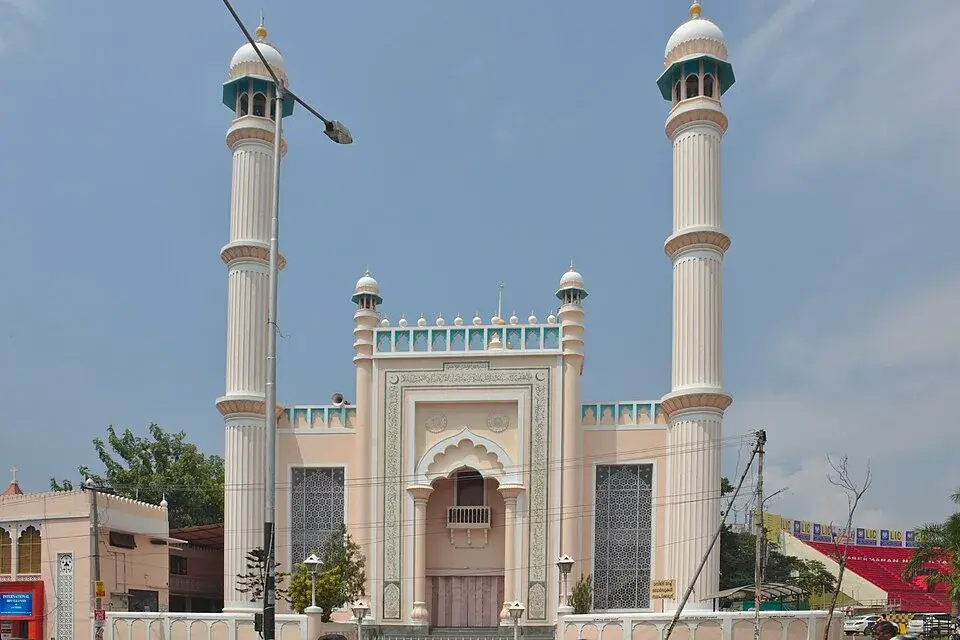 Photo: Shishirdasika · CC BY-SA 4.0