A striking museum complex at Anandpur Sahib that tells five centuries of Sikh history and the birth of the Khalsa through art, light and sound.
Anandpur Sahib is one of the holiest towns of Sikhism. It was founded by Guru Tegh Bahadur, and here on Baisakhi in 1699 Guru Gobind Singh established the Khalsa, the community of initiated Sikhs. Virasat-e-Khalsa, a large museum rising beside the town, was created to tell that heritage to pilgrims and visitors of every background.
The complex was conceived around the three hundredth anniversary of the Khalsa in 1999, and its first phase was opened to the public in November 2011. The architect Moshe Safdie designed it as a group of sandstone structures with curved stainless steel roofs, set on the slopes of a valley and linked by a long bridge across water. The forms recall the fortresses of the region, while the reflective roofs turn towards the sky. One cluster, with petal like shapes, suggests an open hand or flower and has become the emblem of the place.
Inside, the story unfolds through galleries that rely on atmosphere as much as on objects. Hand painted murals, carved and crafted installations, films, shadows, lighting, music and narration lead visitors through the landscape and culture of Punjab, the life and teaching of Guru Nanak, the succession of the Gurus, the compilation of scripture, the martyrdoms, the founding of the Khalsa and later history. An audio guide, available in several languages, responds to your position and is central to the experience, so wear it and let the sequence set your pace.
The scale of the mural galleries impresses many visitors, as does a tall space representing Punjab. Later sections deal with the struggles of the community in the eighteenth century and after. The museum has been described as the most visited Sikh museum, and queues form on weekends and festival days.
Entry has generally been free, but visitors may need to obtain a pass or take a timed turn, with identity details recorded. The museum is usually closed one day a week and for maintenance periods during the year. Check current timings and entry procedures before travelling. Cameras, phones, large bags and food may have to be deposited. Lifts, ramps and staff assistance help those with limited mobility, although the route is long. Smoking and tobacco are strictly forbidden in this sacred town.
Allow two to three hours, and combine the visit with the Takht Sri Keshgarh Sahib, the gurdwara on the spot associated with the creation of the Khalsa and one of the five seats of Sikh authority. Remove shoes, cover your head and share langar if you wish. Other gurdwaras, including Sis Ganj and the forts such as Anandgarh Sahib, mark further events.
Hola Mohalla, celebrated around Holi, is the town's greatest festival, with processions, martial displays by Nihangs and enormous crowds. It is spectacular but requires patience and early booking, and the museum's arrangements may differ.
The drive offers more: the Bhakra Nangal dam region to the north east, the temple of Naina Devi on a nearby hill in Himachal Pradesh and the wetland on the Sutlej at Rupnagar. Chandigarh, with its planned architecture and Rock Garden, is a convenient base.
October to March brings pleasant weather, with the sandstone glowing warmly in winter sun. Visitors unfamiliar with Sikh history often say that the galleries give them a clear and moving introduction, while families from the community find a place to pass memory to the next generation. Both are served by taking time and listening closely.
Take a break on the bridge between the two sections to look across the water towards the roofs and the gurdwaras of the town. It is a good moment to talk over what you have seen before entering the next set of galleries.
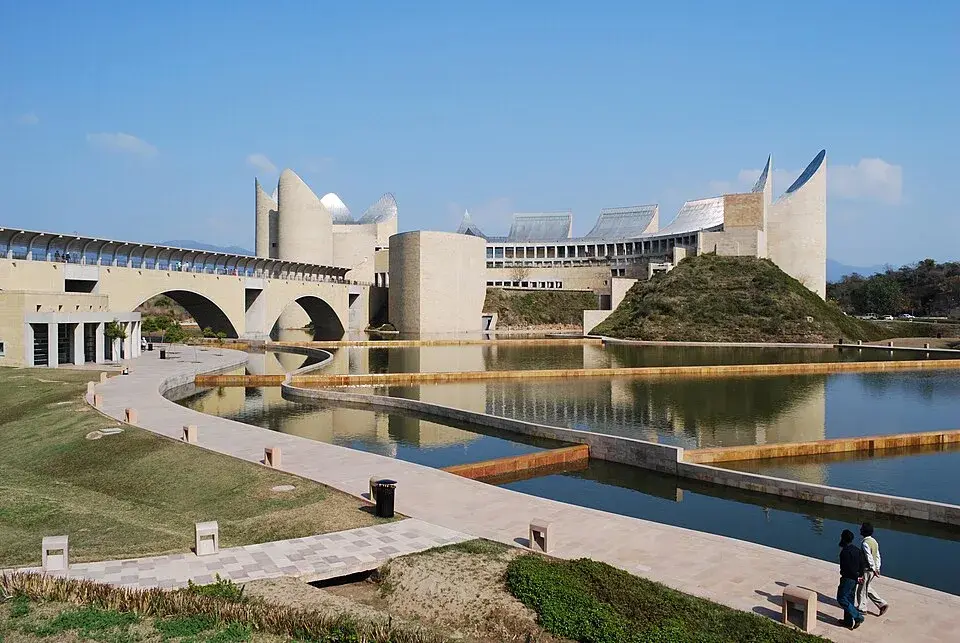 Photo: Sanyambahga · CC BY-SA 3.0