
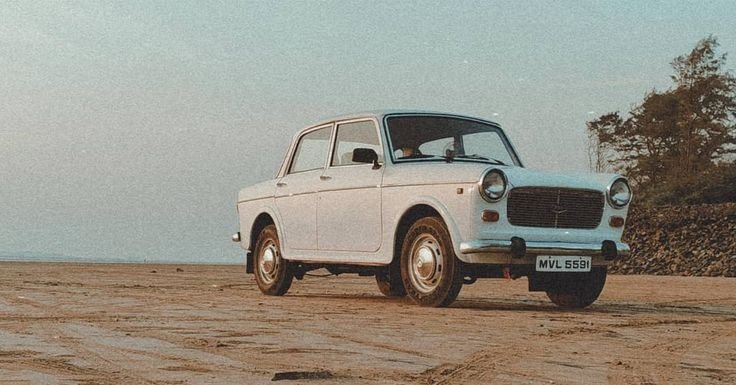
There was a time in India when the idea of owning a car was not driven by convenience, speed, or features, but by patience, aspiration, and pride. In that era, the Premier Padmini was not merely a mode of transport—it was a milestone in a family’s life. For many Indians, this modest-looking sedan symbolized arrival: a reward for years of saving, waiting, and dreaming. Long before modern hatchbacks and SUVs flooded the market, the Premier Padmini quietly defined what personal mobility meant in a young nation finding its feet.
The India That Gave Birth to the Padmini
To understand the Premier Padmini, one must first understand the India of the 1950s and 60s. The country followed a tightly controlled economic system where imports were restricted and manufacturing licenses were difficult to obtain. Foreign automobile companies could not operate independently, and Indian manufacturers relied heavily on collaborations to access global technology. Car ownership was rare, roads were unpredictable, and fuel quality varied widely. Any car that succeeded in such conditions had to be simple, durable, and forgiving.
It was within this environment that Premier Automobiles Limited, already an established name in commercial vehicles, decided to expand its passenger car ambitions.
Fiat and Premier Automobiles: A Partnership of Necessity and Vision
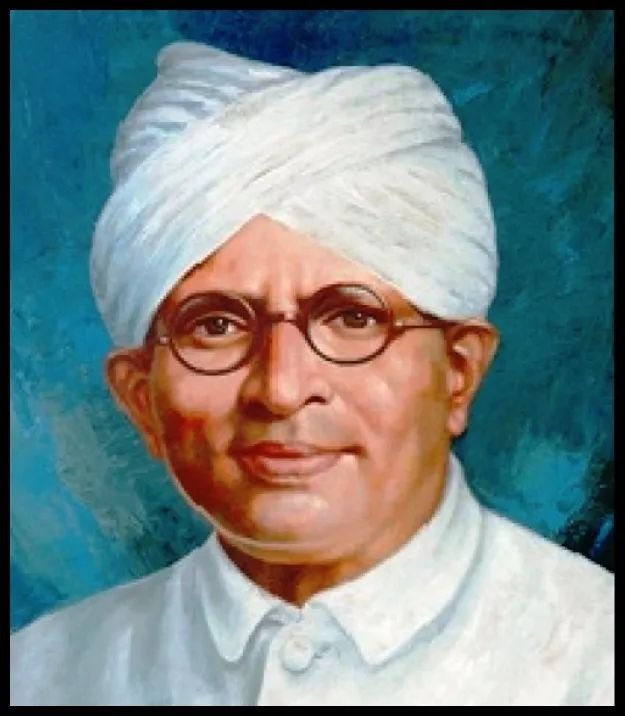
Premier Automobiles Limited, founded in 1944 by industrialist Walchand Hirachand, had the manufacturing capability but needed proven passenger car technology. Fiat, on the other hand, had decades of experience building compact, reliable cars but was restricted by Indian regulations from entering the market directly. The solution was collaboration.
Under this partnership, Fiat provided vehicle designs, engines, and engineering expertise, while Premier handled local manufacturing, sourcing, and distribution. This collaboration led to the Indian production of several Fiat-based models, gradually adapted to suit local conditions. Over time, Premier gained enough confidence and market understanding to localize not just production, but also identity.
That evolution culminated in the Premier Padmini.
From Fiat 1100 to an Indian Icon
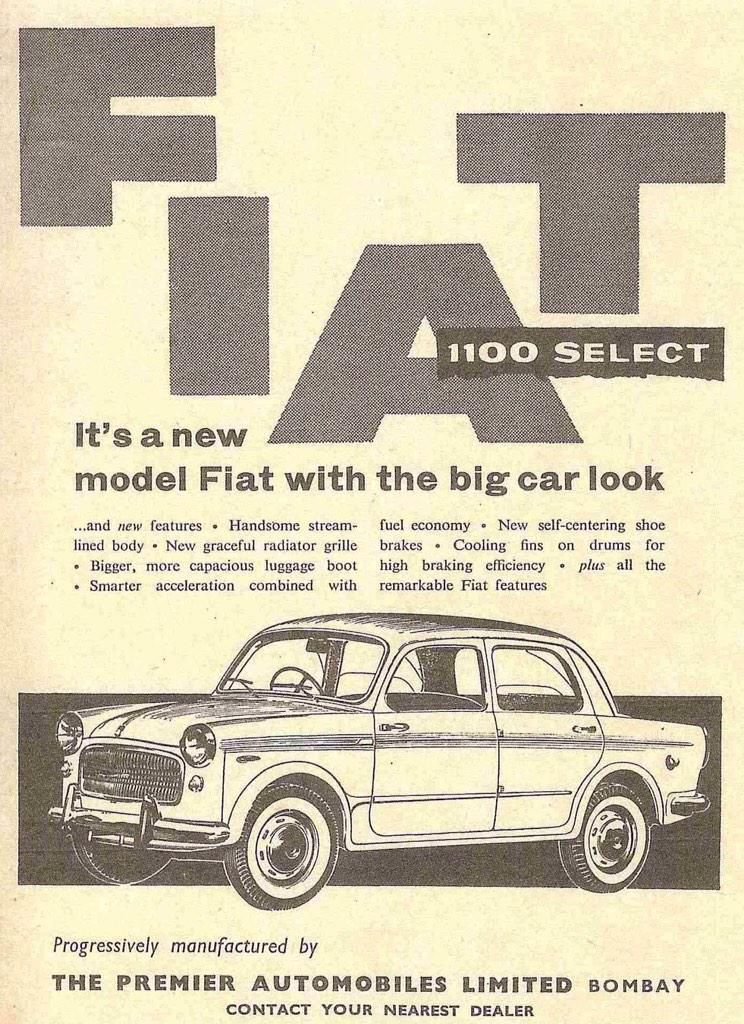
The Premier Padmini was derived from the Fiat 1100D, a car already respected internationally for its balanced design and dependable mechanics. However, the Indian version was subtly adapted to handle rougher roads, hotter climates, and longer service intervals. When it was introduced in 1973, it entered a market dominated by the Hindustan Ambassador, which was larger and more imposing.
The Padmini offered something different. It felt compact, lighter, and easier to live with, especially in crowded cities. While supply remained limited and waiting periods stretched into years, demand never faded. Owning a Padmini was not about instant gratification—it was about long-term commitment.
Why the Name “Padmini” Mattered
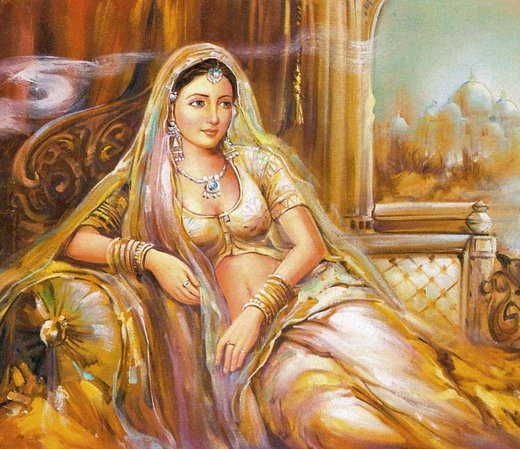
Unlike its Fiat ancestors, which carried numeric names, the Premier Padmini was given a distinctly Indian identity. The name “Padmini” was inspired by Queen Padmini, also known as Rani Padmavati, a legendary figure associated with grace, dignity, and strength.
By choosing this name, Premier Automobiles signaled that this was no longer just an imported design—it was a car rooted in Indian culture.
The name carried elegance without sounding extravagant. It appealed to middle-class families who valued respectability and tradition. Over time, “Padmini” became a household word, spoken with familiarity and affection.
Design That Favored Function Over Fashion
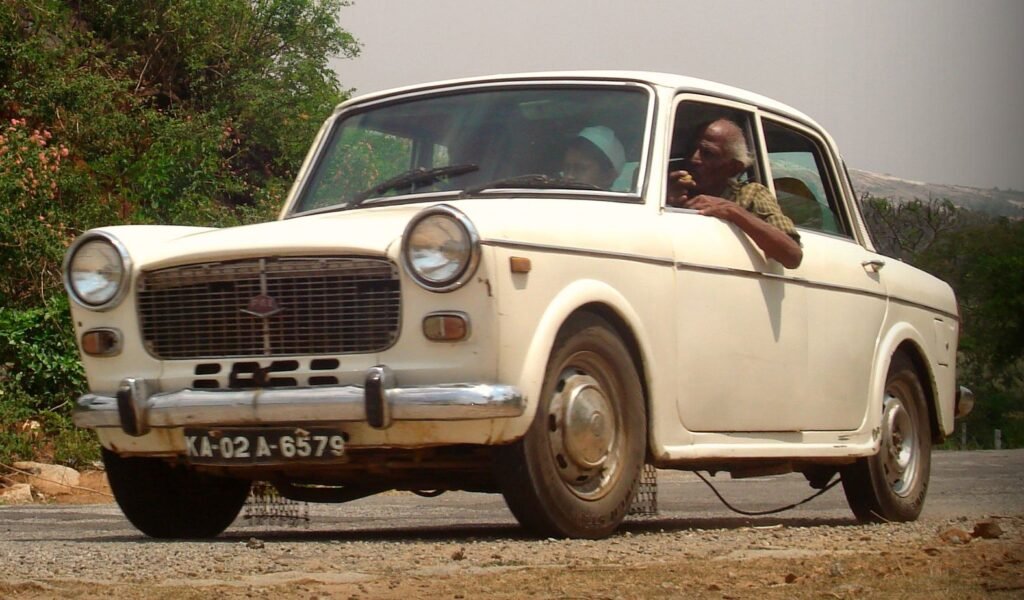
The design of the Premier Padmini was conservative even by the standards of its time, but it aged gracefully. Its proportions were balanced, its lines clean, and its stance confident without being aggressive. Round headlamps, a simple chrome grille, and a straightforward three-box silhouette gave it a timeless appearance.
Inside, the car reflected the philosophy of purposeful simplicity. The dashboard housed only essential instruments, the seating was upright and supportive, and visibility was excellent. There were no unnecessary frills, but there was a sense of solidity that reassured owners. Everything felt built to last.
The Engine That Defined Its Character
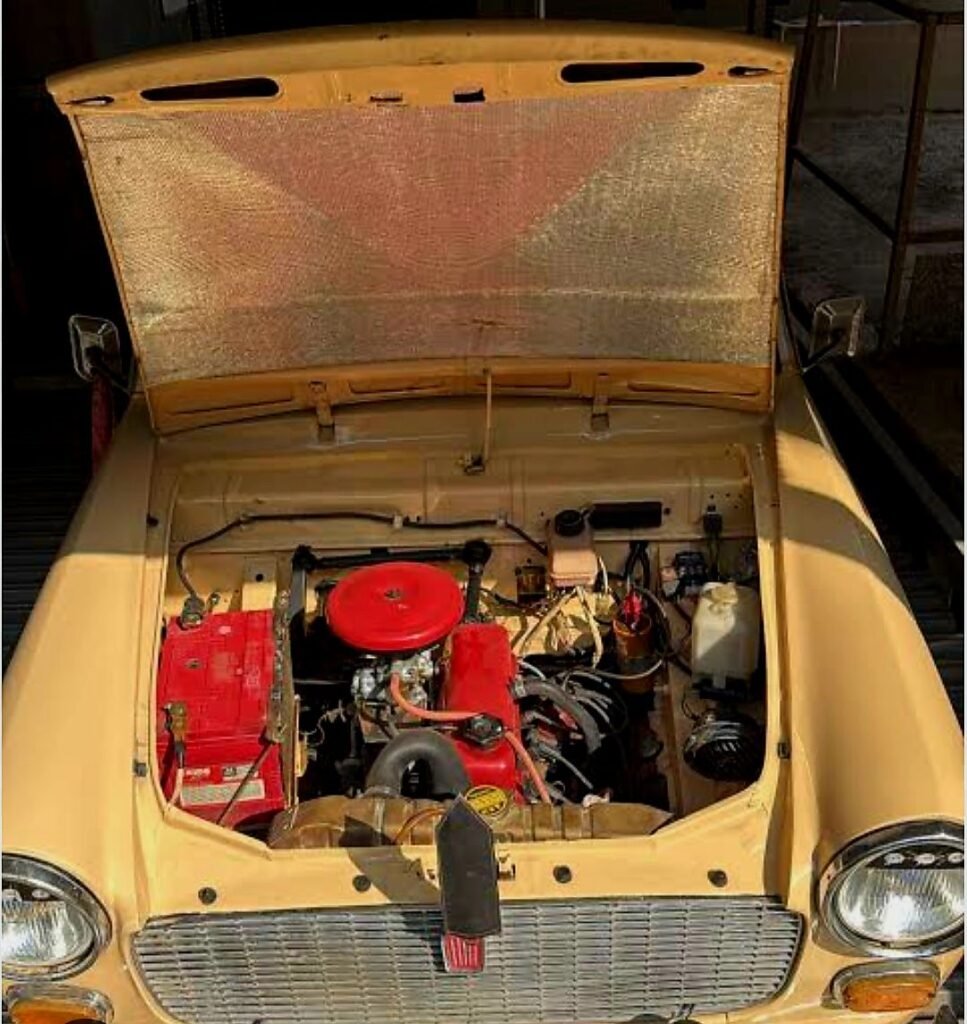
Powering the Premier Padmini was a naturally aspirated four-cylinder petrol engine with a displacement of 1089 cubic centimetres. Producing just over forty horsepower, the engine never aimed to impress on paper. Instead, it delivered power smoothly and predictably, making it well-suited to everyday driving.
The engine’s real strength lay in its resilience. Designed with a low compression ratio, it could handle inconsistent fuel quality without complaint. The carbureted fuel system was mechanically simple, allowing even small-town mechanics to service it with ease. Cooling was effective enough to cope with Indian summers, and the engine’s long-stroke design favored low-end torque over high-rev performance.
Power was sent to the rear wheels through a four-speed manual gearbox, a layout that provided balanced handling and a relaxed driving experience. While acceleration was modest, the car felt stable and composed at cruising speeds, encouraging smooth and patient driving.
Suspension, Ride, and Everyday Driving
The Padmini’s suspension setup was tuned for comfort rather than sportiness. Independent front suspension and a leaf-spring rear allowed the car to glide over uneven surfaces that would unsettle stiffer vehicles. This made it particularly suitable for long family journeys on unpredictable roads.
Steering was light, visibility was excellent, and the car felt easy to place even in narrow streets.
However, braking relied on drum brakes on all four wheels, which required anticipation and measured inputs. Safety, as understood today, was minimal, but for its era, the Padmini behaved predictably and honestly.
Variants: Evolution Through Practical Needs
Over its long production life, the Premier Padmini evolved gradually, shaped more by necessity than ambition.
The Padmini Deluxe became the most recognizable version. Aimed squarely at private buyers, it offered the petrol engine in its familiar form, paired with slightly improved interior finishes and chrome exterior detailing. For middle-class families, this variant struck the perfect balance between affordability and pride of ownership.
As expectations slowly changed, the Padmini S1 was introduced with subtle refinements. Electrical systems were improved, cabin comfort was enhanced, and mechanical tuning made the driving experience smoother. These changes did not transform the car, but they reinforced its reputation for dependability.
The Padmini S2 followed with further refinements, including better braking performance and improved seat cushioning. By this stage, the Padmini had become less of an aspirational purchase and more of a trusted companion, valued for reliability over novelty.
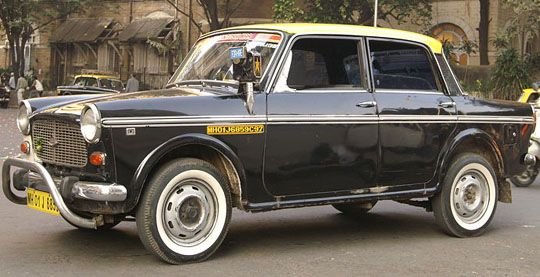
The most transformative variant was undoubtedly the Padmini 137D, the diesel version. Introduced to address rising fuel costs and commercial demand, this variant featured a diesel engine that prioritized torque and efficiency over refinement. It quickly became the backbone of taxi fleets, particularly in Mumbai, where it ran tirelessly for years with minimal downtime. The diesel Padmini extended the car’s relevance well into the 1990s.
The Padmini in Indian Life and Culture
Few cars have been as deeply embedded in Indian society as the Premier Padmini. In Mumbai, the black-and-yellow Padmini taxi became an unofficial symbol of the city itself. In films, the car often represented honesty, simplicity, and middle-class values. Government departments relied on it for its ease of maintenance and predictable behavior.
The Padmini was not admired for performance or luxury—it was respected for reliability and familiarity.
Decline and the End of an Era
The arrival of the Maruti 800 marked a turning point in Indian motoring. Suddenly, buyers experienced front-wheel drive, better fuel efficiency, modern interiors, and reliable after-sales support. As the Indian economy opened up in the 1990s, global standards rose rapidly.
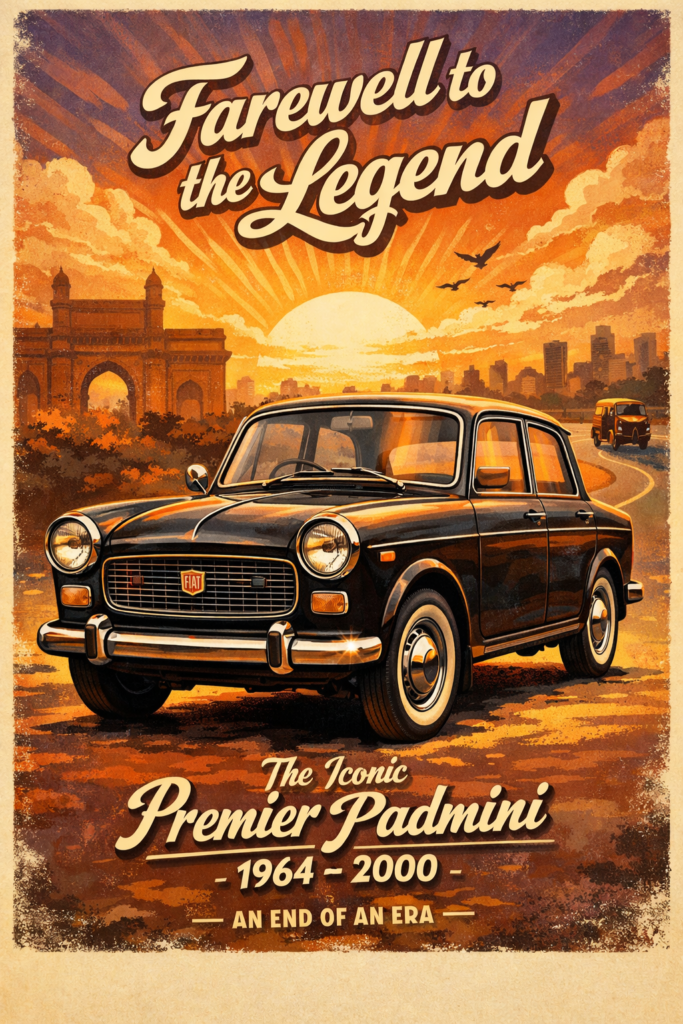
The Premier Padmini, built on decades-old architecture, struggled to meet new emission norms and evolving safety expectations. In 1998, after nearly twenty-five years of production, the car was discontinued, quietly exiting the stage it once dominated.
Legacy That Outlives Its Metal
Today, the Premier Padmini lives on as a cherished classic. Restored examples appear at vintage car rallies, lovingly maintained by enthusiasts who value history over horsepower. For many, the car represents childhood memories, family road trips, and a time when progress moved at a gentler pace.
The Premier Padmini may no longer roam Indian roads in large numbers, but its legacy remains firmly parked in the nation’s collective memory.

Excellent article…
The great explanation of a great historically significant car 👏
Good job Rahul✨