An old Shiva temple at Kazhakkoottam with a seated, meditating Shiva and a three-tiered sanctum.
At a glance
What: A temple of Shiva seated in penance.
Where: Kazhakkoottam, north of Thiruvananthapuram city.
When: Daily worship through the year.
How: By train or bus to Kazhakkoottam.
By whom: The Travancore Devaswom Board; the tantric duties are reported to rest with the Tharananalloor family.
For whom: Devotees, lovers of temple architecture and visitors to the technology district.
The temple
Amid the offices and flyovers of modern Kazhakkoottam stands a temple that long predates them. The image in the sanctum shows Shiva seated in tapas, the intense meditation by which, in myth, he withdraws from the world. Devotees approach him as a master of self-control whose stillness holds great power.
The sage in the story
One account credits the consecration of the principal linga to the sage Kalakkodu in the days of the Cheraman Perumal rulers, and links the name of the place to him. In the epics a sage of similar name, Rishyasringa, is the forest-born hermit whose arrival ends a drought. Local tradition about Kalakkodu should be read as sacred narrative, not as a dated record.
Another shrine
A second tradition says that a smaller Shiva shrine, north of the surrounding gallery, was built by the Pillai of Kazhakkoottam. It is easy to confuse the two foundations when stories are retold. Ask to be shown which shrine is which, and listen to how the temple's own servants describe their relation.
The Pillai of Kazhakkoottam
In Travancore history the lord of Kazhakkoottam is counted among the Ettuveettil Pillamar, the nobles of the eight houses who opposed the rising power of Marthanda Varma in the early eighteenth century and were crushed by him. The tale has been much coloured by novels and popular drama. No source consulted here ties those events directly to the temple's building.
How old is it?
Dates disagree. One writer says the present temple was completed in 1470, another places it in the fourteenth century and a third in the tenth. The year 1470 is the most precise, yet none of the accounts shows the evidence behind it. The honest answer is that the temple is evidently several centuries old and that its exact age awaits proper study.
The builders
Construction is attributed to a master mason from Tirunelveli, remembered as Pandikannalan Muthassari, working with carpenters from Kerala. The partnership is typical of the south, where Tamil stoneworkers and Kerala woodworkers each brought a mature craft. The result usually shows granite plinths and pillars below, with timber rafters, carved brackets and tiled or metal roofing above.
Three tiers
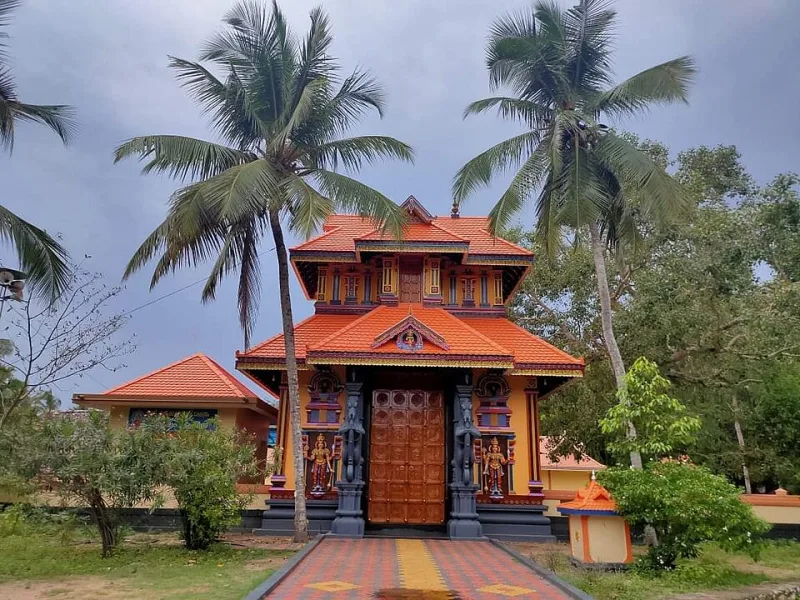
The sanctum is noted for rising in three tiers. Multi-storeyed sanctums are uncommon in Kerala, where a single sloping roof is the norm. Each level reduces in size toward the finial, giving height and dignity. View it from a little distance within the permitted area, and notice how the eaves are designed to throw monsoon rain clear of the walls.
The tantri
In Kerala temples the tantri is the hereditary authority on ritual, responsible for consecration, major festivals and the correction of lapses, while daily worship is done by appointed priests. The Tharananalloor family, associated with several important temples, is reported to hold this office here. Such links tie a local shrine to a wider network of ritual learning.
Worship and offerings
Abhishekam, bilva offerings, lamps, archana and homams are the ordinary forms of devotion. Because the deity is in meditation, devotees often speak of praying here for concentration, calm and perseverance, qualities that students and working people value. These hopes are personal; the temple counter can advise on the offerings that are customary for them.
Shivaratri and festivals
Maha Shivaratri is a major night, with fasting, vigil and crowds. The temple's annual festival follows its own star-based dates, which change on the English calendar. Check the board at the entrance or ask the office. Festival periods bring percussion ensembles and, often, traditional art forms performed within or near the precinct.
The town around
Kazhakkoottam has been transformed by Technopark, begun in 1990 as the state's first information technology park, and by the highway that connects it. Young professionals from across India now live here. The temple provides continuity amid rapid change, and its tank and trees, where preserved, offer relief from concrete.
A name with history
The place gave its name to a ruling house and today to a legislative constituency and a railway station. Explanations of the word differ, and popular etymologies abound. Rather than choose one, note that its repetition across temple lore, political history and modern maps shows how long Kazhakkoottam has been a recognised locality.
Visiting with respect
Follow the dress code, leave footwear outside, and keep phones silent. Photography inside is normally prohibited; ask before photographing even exterior woodwork. Walk clockwise, do not cross the sanctum drain and avoid touching carvings or old walls, which are easily harmed.
Getting there
Kazhakkoottam has a railway station and constant buses on routes between the city, Attingal and the technology campuses. Thiruvananthapuram city centre is about fourteen kilometres south and the airport somewhat nearer. Peak-hour traffic around the junction is heavy.
When to come
Early morning offers quiet and soft light. November to February is comfortable. Shivaratri night is memorable but crowded. During the monsoon, enjoy the way the roofs shed water, and take care on wet paving.
Nearby places
The Kariavattom Sastha temple and Viyyat temple, Puthenthope beach, Veli's lagoon and the Greenfield stadium at Karyavattom are all close.
Facilities
Hotels, restaurants, banks and hospitals are abundant. There is no entry charge.
Looking closely
Spend a few minutes on the details before leaving. Note the granite mouldings at the base of the walls, the way timber joints meet without crowding, the pattern of the brass or oil lamps and the worn steps at the thresholds. These tell of long use. Compare them with a newer temple in the neighbourhood and you will see how craft traditions continue while materials change.
An outing from the tech campuses
Visitors posted to Kazhakkoottam for work often find the temple the easiest introduction to Kerala's religious architecture. An hour in the morning is enough before the office day, and colleagues familiar with local custom can explain the dress and the queue. Weekends allow a longer round including the coast.
Help complete this page
Inscriptions, repair records and dated photographs would help settle the temple's age. Please share them through the links here.