A goddess temple between the sea and the Parvathi Puthanar at Menamkulam, with a legend of Vilwamangalam Swamiyar and a seven-day Meenam festival ending in thookkam.
At a glance
What: A Bhagavathy temple of the coastal plain.
Where: Menamkulam, between the Veli and Kadinamkulam backwaters.
When: Reported worship 5.00 to 9.30 and 5.30 to 8.00; festival on Meena Pooram.
How: By road from Kazhakkoottam.
By whom: Temple management, with tantric duties held by a hereditary Namboodiri tantri.
For whom: Devotees, women offering Pongala and visitors to the northern coast of the city.
The setting
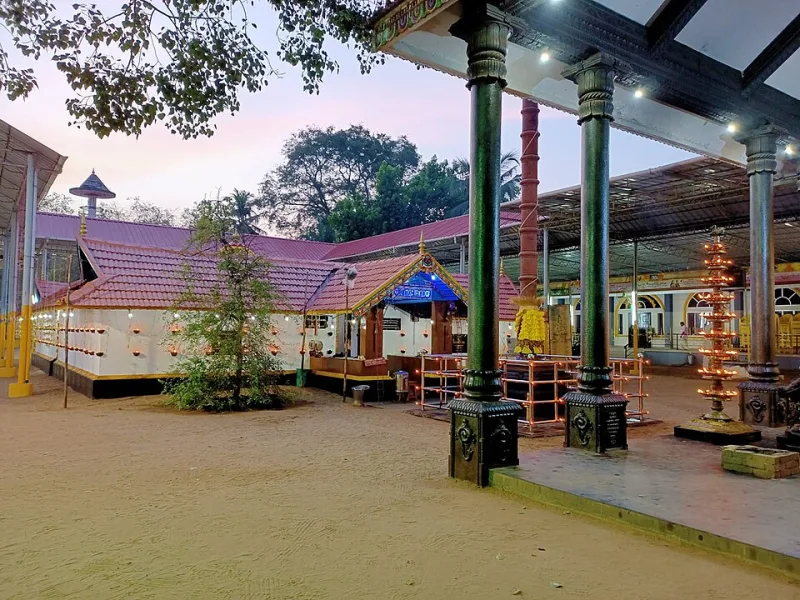
The temple stands west of the highway at Kazhakkoottam, with the Arabian Sea on one side and the Parvathi Puthanar canal on another, between the Veli and Kadinamkulam lagoons. A Malayalam account counts it among the well known goddess temples of southern Travancore and a place of constant comfort to its devotees.
The goddess
The deity faces east and is worshipped in the gentle and auspicious mood of Rajarajeshwari, the queen of queens, also called Sri Chakravartini, sovereign of the sacred diagram. She is the village deity, believed to protect her people and to grant prosperity and goodness.
The Sri Chakra
The Sri Chakra is a figure of nine interlocking triangles within circles and lotus petals, used in the Sri Vidya tradition to contemplate the goddess as the source of the universe. A title linking the deity with it suggests the refined, royal conception of the Devi favoured in that school.
A thousand years?
The temple is believed to be around a thousand years old. That is the community's estimate; no dated evidence is cited. The name is explained by saying that the shrine lies on the shore of the milk ocean where Vishnu dwells. Because it borders paddy land, it was also called Elayil temple.
Vilwamangalam's journey
Legend says that the saint Vilwamangalam Swamiyar, while searching for Ananthankadu, the forest where Padmanabha would reveal himself, passed many shrines and reached Menamkulam, then wooded. He stayed as the guest of a Brahmin family and installed for their worship Sri, goddess of wealth and beauty, consort of Vishnu.
Who was Vilwamangalam?
Stories of Vilwamangalam appear at many Kerala temples, including the founding legend of Sree Padmanabhaswamy. Tradition may refer to more than one holy man of that name, one associated with the Sanskrit poem Krishna Karnamritam. As a legendary traveller he connects scattered shrines into one sacred geography.
Servants of the great temple
The account continues that descendants of Nairs who had come from north and south to work for the Padmanabhaswamy temple were appointed trustees here and were granted land around the shrine and house. They cleared the forest, grew paddy, parboiled it and sent rice to the great temple.
An economy of devotion
Whether or not every detail is exact, the story describes how temples once organised land and labour. Grain flowed from villages to central shrines, and village trustees held rights in return for duties. It helps explain the close connections between small temples of this coast and the temple in the heart of the capital.
From mirror to image
At first the installation was a kannadi pratishtha, a mirror, standing for the formless presence of Bhadrakali. Later a reconsecration took place, and in 1985 the temple was rebuilt, with an image of Durga bearing conch and discus, gestures of protection and giving, and feet resting on a lotus.
Mirror worship
The mirror is a profound symbol: the worshipper approaching the deity meets a reflection and is invited to recognise the divine within. Sree Narayana Guru also consecrated a mirror at one of his temples. Several goddess shrines of Kerala preserve mirror or sword forms from earlier worship.
Two equal powers
Worship gives equal importance to the Bhagavathy and to the attendant Bhadrakali. Other deities are Mahadeva, Dakshinamurthy, Ganapati, Raktheshwari and the serpents. Dakshinamurthy is Shiva as the silent teacher who faces south, approached by students and seekers of knowledge.
Offerings
Devotees offer archana, food offerings, abhishekam, a covering of turmeric paste, payasam, kumkuma abhishekam, Bhagavathi seva and lamps. Every full-moon day brings special worship and Bhagavathi seva, an evening rite performed with a lamp set on a decorated floor design.
The tantri
Tantric authority is held by a member of the Kuzhikkattu illam of Thiruvalla, described as also serving the Attukal temple. The connection links this coastal shrine with one of the most visited goddess temples in India.
The festival
The annual festival centres on the Pooram star in Meenam, the birth star of the goddess, and lasts seven days. On the Makayiram star those who will perform thookkam are chosen by lot, and the same day the thottam songs invoke the goddess and install her presence, opening the celebrations.
The seventh day
The final day, Meena Pooram, brings urul, a vow of rolling in devotion; Pongala; arattu, held in the pond of a subsidiary grove shrine of Yakshiamma; thookkam; and the procession of lamps called thalappoli. The thookkam performers return in costume with the goddess from the Kalari Bhagavathy shrine.
About thookkam
Thookkam is described as a rite recalling ancient human sacrifice, transformed into a harmless offering. Participants keep seven days of vows, dress somewhat like an oracle, circle the temple and are then suspended from a raised beam before the goddess. Safety rules apply, and onlookers must keep their distance.
Visiting with respect
Modest traditional dress, bare feet and silence are expected. Photographs of rituals need permission. During the festival obey volunteers, and do not stand under the moving frame.
Getting there
Kazhakkoottam has a railway station and frequent buses; autorickshaws reach Menamkulam in minutes. The city centre is about fifteen kilometres away and the airport about eleven.
When to come
Morning worship is calm. The festival in March or April is vivid and hot. November to February is the best season for the coast.
Nearby places
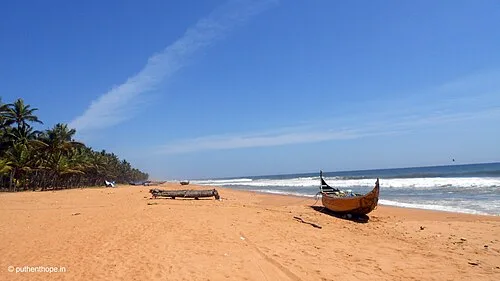
Puthenthope beach, Kazhakkoottam Mahadeva temple, Veli tourist village and Thumba's coast are close by.
Facilities
Shops and eateries are found toward Kazhakkoottam. There is no entry fee.
Land between waters
The canal beside the temple belongs to a chain of waterways that once carried goods and passengers along the coast to the capital. Boats loaded with rice, coir and salt passed where roads now take the traffic. Imagining that journey helps the legend of grain sent to the great temple feel concrete. Present-day works to revive the water route may change the banks, so take care along the edges and follow local signs.
Visiting with the coast in mind
A morning that begins with worship here can continue to the sea a short distance away. Change out of beach clothes before returning to any shrine, rinse sand from your feet and keep temple courtesy in mind among the fishing homes, where people live close to the road.
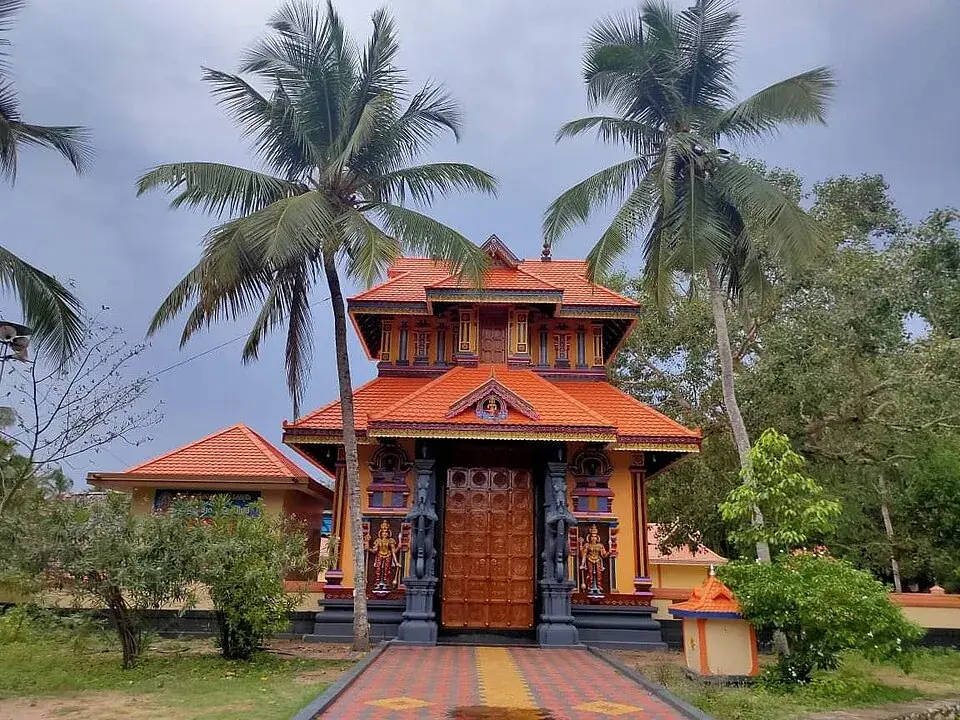 Photo: Sarath · CC BY-SA 4.0