A ninth century Shiva shrine cut into a hill of rock near the capital, with an old Vattezhuthu inscription, a bamboo walkway and wide views.
At a glance
What: An early rock cut temple on a rocky hill.
Where: Madavoorpara, on the edge of Thiruvananthapuram city.
When: Dated around the ninth century.
How: By road, followed by a climb of steps.
By whom: Protected by the State Archaeology Department; worship managed by a religious mission.
For whom: History lovers, devotees, families and walkers.
The rock and the shrine
A great outcrop rises about three hundred feet, and part way up a small chamber has been hollowed into it. Inside is Shiva, with a carving of Ganapathy on the wall to one side and a figure usually described as a local chieftain on the other. The images are worked in relief from the living stone. More than two hundred steps are mentioned in one account of the climb.
Date
The state tourism department dates the shrine to the ninth century. Another account gives the year 850, and others a broader span from the seventh to the ninth century. All agree that it is among the oldest surviving works of its kind near the capital, well over a thousand years old.
The inscription
An ancient inscription in Vattezhuthu, the rounded script once used for Tamil and early Malayalam, is preserved at the site. Such writing helps scholars place a monument in time and learn about gifts, rulers and arrangements for worship. Do not touch the lettering, chalk it for photographs or rub it with paper.
Who made it?
Theories vary. One holds that a Buddhist monk built the shrine, another that Jains did, and these ideas are often repeated because Kerala's early religious history included both traditions. The images now present are of the Shaiva tradition. Without clearer evidence the earlier use, if any, must be left open.
Protection
The premises have been under the care of the State Archaeology Department, reported as protected since 1960. A pamphlet account notes that the cave was earlier held by the Chenkottukonam ashram, and the temple is managed by the Sree Rama Dasa Mission. Worshippers and sightseers therefore share the site.
The bamboo bridge
A bamboo walkway about a hundred metres long has been built over part of the rock and is now an attraction in itself, along with bamboo shelters at the top. The views over coconut groves, rubber and the spreading city are generous. Bamboo structures weather quickly, so use only those that are open and sound.
Ganga Theertham
Near the summit, beside a pale leafless tree noted by visitors, is a small pond called Ganga Theertham that is said never to run dry. Rock pools fed by seepage and rain often hold water long into summer, and devotion names this one after the holiest of rivers. Keep it clean and do not bathe in it unless custom allows.
Facilities and plans
A children's park with swings and slides has been mentioned, and tourism plans have proposed further facilities such as an amphitheatre, cottages and a cafeteria. What exists on the day may differ.
Getting there
Drive from the city by way of Sreekaryam and Chengottukonam. Local buses stop within walking distance and autorickshaws are readily available. Kazhakkoottam and Thiruvananthapuram Central are the useful railway stations, and the international airport is within an hour.
When to go
Choose early morning or late afternoon, when the rock is cool. October to February is the best season. In the monsoon the stone is slippery and lightning is a danger on exposed tops; leave at once if a storm approaches. Summer midday is punishing.
Safety
Hold rails on the steps, do not wander onto sloping rock, supervise children closely and carry water. People with heart or knee trouble should climb slowly or enjoy the lower grounds.
Respect
Remove footwear at the shrine, dress modestly and keep voices low. Do not paint names, litter or play loud music. Nature and an ancient monument share this hill.
Nearby places
The Chempazhanthy birthplace of Sree Narayana Guru, the Sreekaryam side temples, Akkulam lake and the Vizhinjam rock cut cave temple, another early example, can be paired with the visit.
Questions visitors ask
Is there a ticket? Charges may apply to tourism facilities; confirm at the site. Is it open daily? Worship and visiting hours should be checked. How hard is the climb? Moderate. Is photography allowed? Generally outside the shrine; ask within.
Standing on the rock
From the top, the old shrine below and the new suburbs around make a single picture of continuity and change. The sculptors who cut the chamber looked out on forest and fields; the visitor looks out on rooftops, with the same wind crossing the stone.
Script and language
Vattezhuthu, meaning rounded writing, was used for many centuries in the southern country on temple walls, copper plates and palm leaf accounts. It gradually gave way to the forms from which the modern Malayalam alphabet developed. Reading it needs training, and each newly studied inscription can add a king's regnal year, a place name or a word otherwise lost. Even without reading it, a visitor can trace with the eyes the flowing curves left by a mason who expected the words to last.
Plants and creatures of the rock
Bare rock heats and cools quickly, so only hardy plants cling to its cracks. After rain, small flowers appear in shallow soil, frogs call from the pools and dragonflies patrol. Kites ride the rising air. Look but do not collect; these small habitats are easily destroyed by trampling.
Evening visit
Late afternoon light warms the stone and lengthens the shadows in the relief carvings. Leave before closing and descend while the steps can still be seen clearly.
What to carry
Water, a cap, shoes with grip and a bag for litter are enough. Binoculars help in picking out landmarks from the summit.
With a group
School and family groups should agree on a meeting point at the foot, keep one adult in front and one behind on the steps, and remind children that the rock edges beyond the rails are not for exploring.
Leaving the hill as it was
Carry down every wrapper and bottle, leave stones where they lie and resist adding offerings in places not meant for them.
A quiet request
If worship is under way, wait below the shrine until it ends.
Finding it
Ask for Madavoorpara at Chengottukonam junction; local people point the way readily.
The view of the shrine from below is worth a final pause.
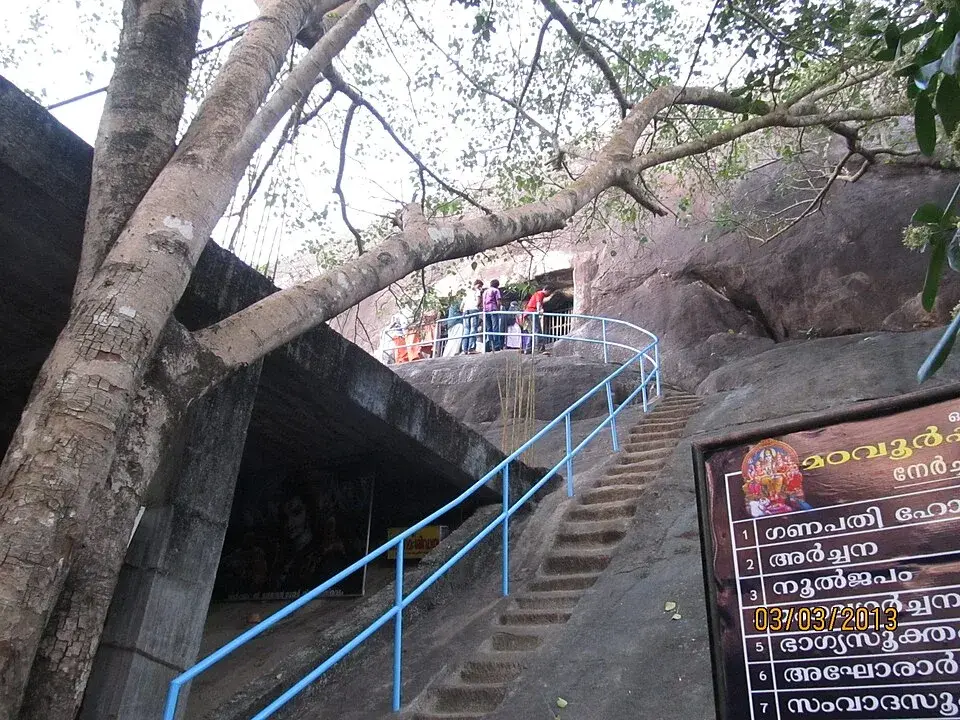 Photo: Viswajithg · CC BY-SA 3.0