A museum opened in 2014 that displays complete profiles of all 82 soil series of Kerala, an unusual lesson in the ground beneath us.
At a glance
What: A museum devoted to soils, their formation, use and protection.
Where: Parottukonam, Thiruvananthapuram.
When: Inaugurated on 1 January 2014.
How: Travel by road from central Thiruvananthapuram.
By whom: Set up by the Department of Soil Survey and Soil Conservation of Kerala.
For whom: School and college students, farmers, planners, gardeners and the curious.
About the museum
Most museums ask us to look at things made by people. This one asks us to look down. The Kerala Soil Museum occupies part of the premises of the Central Soil Analytical Laboratory and presents the astonishing variety of soils found in a narrow state. It has been described as the world's largest soil museum and as the first in India established to international standards.
Its centrepiece is a set of 82 display columns, each about 1.5 metres tall, preserving an undisturbed vertical section of one of the 82 soil series recognised in Kerala. Side by side they form a striking palette of red, brown, yellow, black and grey, with bands, stones and root traces that tell how each developed.
How a monolith is made
Lifting a column of soil without mixing its layers is delicate work. A pit is dug to expose a clean face, a frame is fitted against it and the section is cut free as a single block. Each monolith then underwent at least a month of processing before it could be mounted. Beside it, information explains physical character, places of occurrence, nutrient status, suitable crops and advice on use and management. Classification follows the soil taxonomy of the United States Department of Agriculture, widely used by scientists. Staff were trained by specialists from the World Soil Museum at Wageningen University in the Netherlands.
Other exhibits
There are geological and soil maps, including the distribution in Kerala of the eight soil orders represented there, collections of rocks and minerals and samples of the building blocks of soil: clay, silt, sand, stone and gravel. Panels explain how soil forms and how it relates to food security and a changing climate. A Soil Information Centre adjoins the display.
Why Kerala's soils matter
Within a few dozen kilometres the land climbs from sandy coast to laterite midlands to forested mountains, under rainfall that can exceed three metres a year. Heavy rain leaches nutrients and washes away exposed slopes. Laterite, the reddish rock and soil rich in iron and aluminium, can be cut into building blocks that harden in air, and the word itself, from the Latin for brick, was coined by a scientist who observed its use in Malabar in the early nineteenth century. The waterlogged acid soils of Kuttanad, farmed below sea level, are another world altogether.
Soil in story and belief
Indian thought counts earth among the five elements and honours the goddess Bhumi. In Kerala, farming festivals, the first harvest offering and the custom of respecting the land before ploughing express the same gratitude. The popular legend that the sage Parasurama raised Kerala from the sea and that the serpent king made its salty soil fertile is a mythic account of precisely the question this museum studies scientifically: how land became able to feed people.
Misconceptions and facts
It is often said that soil is a renewable resource that can be replaced at will. In reality a few centimetres can take centuries to form and be lost in a single severe storm if the surface is bare. Another common belief is that more fertiliser always gives more crop; excess can damage soil and water. A soil test, which laboratories such as this one carry out, guides sensible use. The August floods and landslides of recent years have made the stability of slopes a matter of public concern.
Reading a soil profile
Scientists describe a profile in layers called horizons. At the top lies the darker zone enriched by fallen leaves, roots, insects and microbes. Beneath it, water carries fine clay and dissolved minerals downward, leaving some layers paler and others denser. Deeper still comes weathered rock, and finally the parent material from which the soil developed. Colour offers clues: rich reds often indicate well drained soil with iron oxides, grey and mottled tones suggest prolonged waterlogging, and blackness may point to organic matter or particular clays. Compare three columns from coast, midland and mountain and see how many differences you can list.
Protecting what lies underfoot
Everyone can help. Keep ground covered with mulch or plants, follow contours when digging on slopes, compost kitchen waste, avoid burning leaf litter and keep plastic and chemicals out of the earth. Farmers have long used bunds, terraces and mixed gardens, the familiar Kerala homestead with coconut, plantain, pepper and tubers together, which shelter the surface through the rains.
Combining study and observation
Teachers can ask students to sketch three monoliths in colour, label the layers and note the crop suggested for each, then match them to a map of Kerala. Families from farming areas may enjoy finding the series that occurs in their own district and discussing whether the description matches their experience in the field.
Visiting
A signboard photographed at the gate gives the working time as 10.15 am to 5.15 pm on all government working days; confirm this before visiting, since hours can change. Groups should write or telephone in advance so that someone can explain the displays. Do not touch the monoliths, which are easily damaged. Photography may require permission.
One hour is sufficient for general visitors; students may wish to stay longer.
Questions visitors ask
Is it only for scientists? Not at all. The colours and layers are interesting to anyone, and gardeners gain practical ideas. Can I bring my own soil for testing? Ask the laboratory about procedure and charges. How should a child prepare? Encourage them to collect a spoonful of garden soil, shake it in a jar of water and watch the layers settle, then compare with what they see here.
Around the museum
The northern part of the city has major research and educational institutions, the Mar Ivanios College campus, and easy routes to the museum area and Kanakakkunnu. Pair the visit with the science museum and planetarium for a day that travels from underground to outer space.
A question to take home
After seeing the profiles, look at an excavation or road cutting in your own neighbourhood. You will probably find layers you never noticed before.
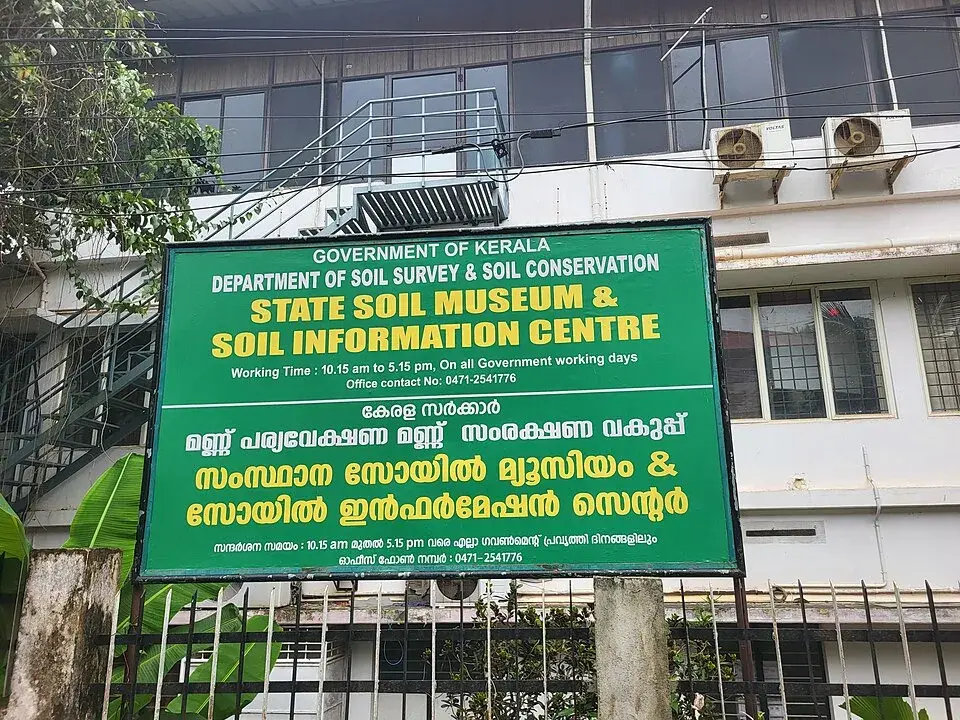 Photo: Athulvis · CC BY-SA 4.0