A spot mapped as the Poonthran memorial near Vakkom, bearing the name of the family into which the reformer and newspaper owner Vakkom Moulavi was born.
At a glance
What: A place recorded on open maps as a memorial called Poonthran.
Where: The Vakkom area near Kadakkavoor, in the north of Thiruvananthapuram district.
When: Present opening arrangements, if any, are unknown.
How: By road from Kadakkavoor, Attingal or Varkala.
By whom: The owner or caretaker has not been identified.
For whom: Readers of Kerala's reform history and local heritage explorers.
What is known
Open map data marks a point near Mosque Road with the name Poonthran and classes it as a memorial. Poonthran is recorded as the name of a prominent Muslim family of old Travancore, and it was into this family that Vakkom Moulavi was born in 1873. No published description of the marked spot itself has been found, so the link between the map point and any particular house or monument remains to be shown.
The family
According to biographical accounts, the family had come from Colachel, now in Tamil Nadu, and its members played a notable part in Travancore's life from the nineteenth century. Its genealogy begins with a landholder named Thoppil Thampi who settled at Vettoor near Varkala. Moulavi's maternal forebears are traced to Hyderabad and Anchuthengu.
Vakkom Moulavi
Vakkom Mohammed Abdul Khader Moulavi lived from 28 December 1873 to 31 October 1932. He was a scholar, teacher, writer, social reformer, journalist and newspaper proprietor. He is widely called the father of the Islamic renaissance in Kerala for urging Muslims to take up modern education and to rid religious life of practices he considered unsound.
A student of many languages
His father, a merchant, brought teachers from distant places to instruct him. He learnt Arabic, Persian, Tamil, Urdu, Sanskrit and English, and one teacher is said to have admitted learning more from the pupil than he had taught. He followed reformist writing from the wider Islamic world, including the journal Al-Manar published in Cairo by Rashid Rida.
Swadeshabhimani
On 19 January 1905 Moulavi founded the weekly Swadeshabhimani, meaning the patriot, and declared that it would not hesitate to expose injustice to the people. He imported a modern press from England. Early operations were linked with Anchuthengu, a small territory under British rule at the time, close to Vakkom.
Ramakrishna Pillai
In January 1906 K. Ramakrishna Pillai became editor, and he later moved with the paper to Vakkom and then, in 1907, to Thiruvananthapuram. Moulavi owned the paper and paid for it but left the editor complete freedom, without a formal contract. That trust between a Muslim proprietor and a Hindu editor is one of the most admired episodes in Kerala's press history.
The crackdown
The paper's sharp criticism of corruption and of the Diwan, P. Rajagopalachari, provoked the government. On 26 September 1910 the newspaper and press were sealed and confiscated, and Ramakrishna Pillai was arrested and banished from Travancore. Moulavi lost a costly press. The episode is still invoked in discussions of freedom of expression, and the confiscated property was returned only after independence.
Why a memorial matters
Families that financed schools, journals and associations shaped public life in ways official monuments often miss. Whether the marked spot is an ancestral house, a plaque or simply a family name attached to land, it points to a household connected with a formative moment in the region's modern history.
Vakkom village
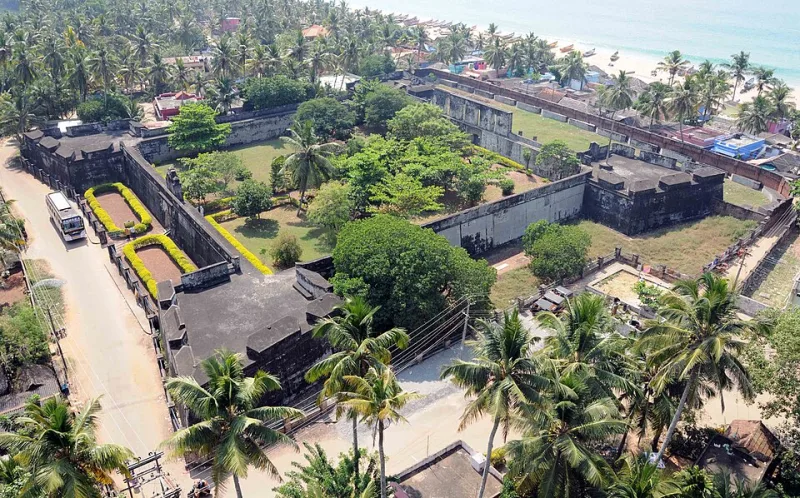
Vakkom is a small panchayat of about five square kilometres, edged by the Anchuthengu backwaters. Coconut palms, canals and close-set homes make up its landscape. It has produced other public figures, among them the freedom fighter Vakkom Majeed and the young revolutionary Vakkom Abdul Khader, a member of the Indian National Army who was executed in 1943.
A later generation
Descendants and relations of the family continued in scholarship, literature, law and politics. One nephew became the first Muslim judge of the Travancore High Court, and several of Moulavi's sons wrote on Islamic studies and literature. A research centre bearing Moulavi's name keeps up lectures, awards and publications.
How to visit responsibly
Because nothing confirms public access, treat the location as you would any village home. Do not open gates or walk through compounds without leave. Greet residents, explain your interest and accept the answer. Dress modestly, particularly near the mosque, and avoid visiting during times of congregational prayer if you are only sightseeing.
Getting there
Kadakkavoor railway station on the Thiruvananthapuram to Kollam line is the nearest railhead. Buses connect the area with Attingal, Chirayinkeezhu and Varkala. Thiruvananthapuram International Airport is about thirty-five to forty kilometres to the south. Village lanes are narrow, so an autorickshaw is more convenient than a large car.
Anchuthengu
The old English settlement of Anchuthengu, with the remains of its fort, a lighthouse, early churches and old graves, lies close by on the coast. It helps explain why a press could operate here under a different jurisdiction from the surrounding princely state, and it makes a rewarding companion visit.
Kaikkara and Sarkara
Kaikkara, the birthplace of the poet Kumaran Asan, has a memorial to one of the leading voices of Malayalam poetry and social change. The Sarkara Devi temple at Chirayinkeezhu, famous for its long festival, is also near. Together these sites show the cultural richness of a small stretch of coast and backwater.
When to come
Daylight hours in the drier season from November to February are the most pleasant. Monsoon rain can flood low lanes near the backwater. Allow only a short time for the marked point and give the rest of the outing to the neighbouring heritage sites.
Facilities
No visitor facilities are known at the spot. Tea shops and small stores serve the village, and Attingal and Varkala offer meals, lodging, banks and hospitals.
Help complete this page
Local readers can settle the open questions: what the memorial is, when it was set up, who looks after it and whether visitors are welcome. Please send details and photographs using the links on this page.
Reading before you go
A little reading makes the visit far richer. Accounts of the Swadeshabhimani affair, biographies of Moulavi and of Ramakrishna Pillai, and histories of the Muslim reform associations of Travancore explain why a family name on a village map can matter. Local libraries in Attingal and Varkala are good places to ask for Malayalam works.
A note on spelling
Local names appear in several English spellings. When asking directions, say the name slowly, mention Vakkom Moulavi and Mosque Road, and show the map pin. Older residents are likely to understand the reference sooner than a satellite map can explain it.