A new museum, partly below ground, at the entrance to the Humayun's Tomb precinct, explaining the Mughal garden tomb and the heritage of Nizamuddin.
Humayun's Tomb has long been one of Delhi's finest monuments, a World Heritage Site where a domed mausoleum of red sandstone and white marble sits in the middle of a walled garden divided by water channels. A museum opened at the site in 2024 now helps visitors understand what they are seeing and places it within the wider history of the Nizamuddin area.
The museum was developed through a conservation partnership involving the Aga Khan Trust for Culture and the Archaeological Survey of India. Much of the building lies below ground level, so that it does not compete with the historic skyline. Its stepped spaces take inspiration from the traditional stepwells of India. Inside, galleries bring together original objects, architectural elements, models, drawings, films and interactive material.
The exhibitions introduce Humayun, the second Mughal emperor, whose reign was interrupted by years of exile before he regained Delhi, only to die soon afterwards. They explain how his widow, Bega Begum, commissioned the tomb in 1558 and how the Persian architects Mirak Mirza Ghiyas and his son designed it. This was the first great garden tomb of the Indian subcontinent and the first structure to use red sandstone on such a scale, and its ideas led eventually towards the Taj Mahal. Other displays deal with the Sufi saint Nizamuddin Auliya, whose shrine lies nearby, the poet Amir Khusrau, the nobleman Rahim and the crafts used in restoring the monuments, from tile making to stone carving.
Separately, a museum devoted to Indian textiles and everyday art was reported to have opened to visitors in August 2026 within the Sunder Nursery side of the complex. Ask at the ticket counter about current galleries and entry arrangements.
See the museum first if you can. With the models and stories fresh in mind, the tomb itself becomes far more rewarding. Enter through the western gateway, pause where the dome is framed by the arch, walk the garden paths, then climb to the high platform to see the screened chambers and the cenotaph. Many other Mughal family members were buried in the building. The tombs of Isa Khan and others in the same precinct are also worth the short detour.
Tickets are required, with different rates for Indian and foreign visitors, and there may be combined or separate charges for the museum. Opening hours and the weekly closing day for the museum may differ from those of the monument, so check both. Security rules limit large bags and food, and photography restrictions apply to some exhibits.
Lifts and ramps serve the museum, while the tomb platform involves steep steps. Summer heat is intense on the open paths, so carry water and a hat. Keep voices low near graves, do not touch carved stone or sit on fragile walls and take rubbish with you.
Sunder Nursery next door is a restored heritage park with lawns, water features, bird life and smaller monuments, ideal for resting afterwards. Across the road the lanes of Nizamuddin basti lead to the saint's dargah, where qawwali is traditionally performed on certain evenings, especially Thursdays; dress modestly and cover your head.
A morning that begins underground among objects and ends beneath the great dome shows how careful interpretation can refresh a familiar landmark. October to March gives the best weather, and early arrival offers softer light and quieter galleries before school and tour groups gather.
Families can turn the visit into a small search: find the models of the double dome, spot the star patterns in stone and compare them with the originals outside. It helps children connect the museum with the monument, and keeps them interested during the longer walk through the garden.
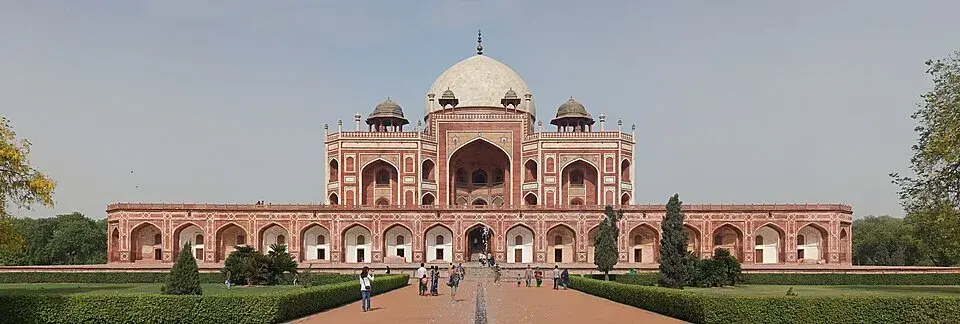 Photo: Muhammad Mahdi Karim · GFDL 1.2