A grand Indo-Saracenic court building of red and pink stone beside the Musi, raised under the seventh Nizam and still the seat of the state's highest court.
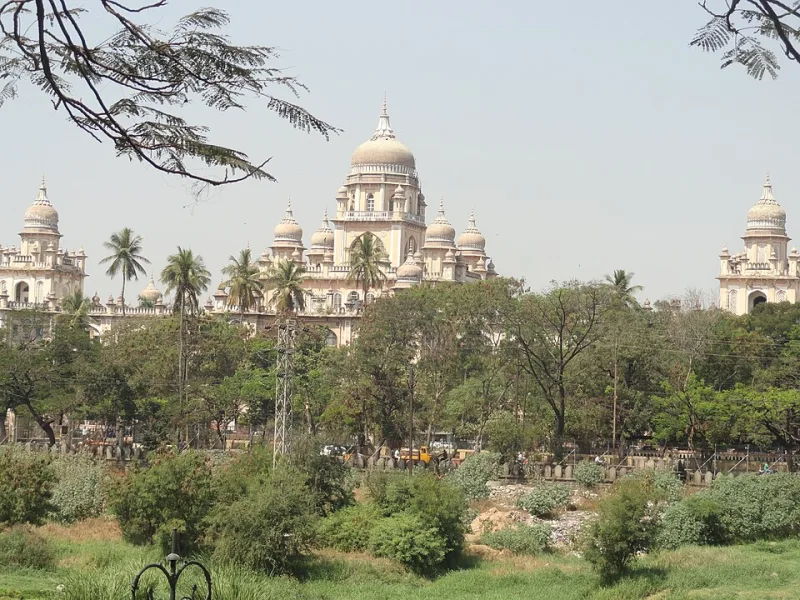
Seen from the bridges over the Musi, the High Court is one of the handsomest buildings in Hyderabad. A long front of pink and red stone rises in tiers of arches, with domes and small kiosks against the sky. It looks like a palace, and it expresses the ambition with which the city was rebuilt in the early twentieth century. Today it houses the High Court of Telangana.
The court was established under the seventh Nizam, Mir Osman Ali Khan, as the highest court of Hyderabad State. The building was completed around 1920. Its story runs alongside the political changes of the region. When Andhra Pradesh was formed in November 1956, the court here became the High Court of that state. After Telangana was created in 2014, it was renamed the High Court of Judicature at Hyderabad and served both states until Andhra Pradesh set up its own court, after which it became the Telangana High Court.
The architecture belongs to the Indo-Saracenic family, which blends Mughal and Deccani forms with the planning of modern public offices. The design is credited to architects who worked on several of the city's notable works of the period. Pointed arches, deep verandas that shade the rooms, projecting balconies, a central dome and corner pavilions create a lively outline. The contrast between granite and sandstone gives warmth, particularly in the low sun.
The flood of 1908 is essential to understanding this part of the city. After the Musi swept away neighbourhoods, a planned programme of reconstruction, with advice from the engineer M. Visvesvaraya, led to flood protection works and a series of fine civic buildings along the banks. The High Court, the Osmania General Hospital and the State Central Library all belong to that era of renewal.
For visitors, the essential point is that this is a working court handling serious matters. The public cannot tour it as a monument. Entry is controlled by security, and passes are issued for those with court business. Enjoy the exterior from permitted public places. Do not point cameras at police posts or entrances, and obey any request to move on. If you are a law student or have a scholarly purpose, enquire through official channels about arranged visits.
The best viewpoints are across the river and from the approach roads, where the whole composition can be taken in. Early morning gives soft light on the facade. On holidays and Sundays traffic is lighter, though the building is closed. In the evenings some of the architecture may be lit.
Be careful on the busy roads, and keep to pavements and crossings. Parking nearby is restricted. Vendors and crowds around the bridges can make the area hectic on working days.
A walk or short drive links a group of landmarks. The Osmania General Hospital's great domes stand across the road area to the west. The State Central Library is on the opposite bank at Afzal Gunj. City College, another fine building in a similar spirit, is close by, and the Salar Jung Museum lies a little to the east. The Charminar and Old City bazaars are a short ride south.
November to February is the best period for sightseeing on foot. In summer the open pavements are punishing at midday, so carry water, and during the monsoon watch for flooding near the river crossings.
Although a visitor may spend only a few minutes here, the High Court rewards attention. It shows how public institutions in Hyderabad State sought dignity through architecture, and how a city devastated by water answered with confident new building. Lawyers in black coats passing beneath its arches remind you that the structure remains alive, doing the work for which it was designed more than a century ago, while the river it faces continues to mark the boundary between the old quarters and the newer city.
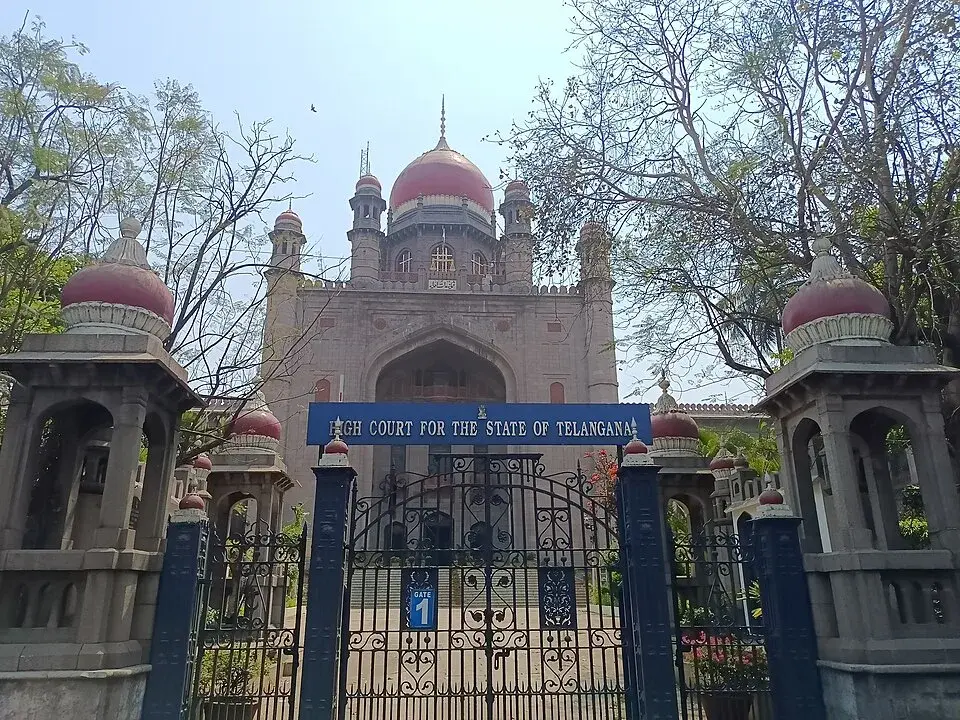 Photo: Tarunsamanta · CC BY-SA 4.0