A temple at Arumanoor where Shiva and Parvati are worshipped as Nainar and Nachiyar, revived on the advice of Sree Narayana Guru.
At a glance
What: A temple of Shiva and Parvati under the names Nainar and Nachiyar.
Where: Arumanoor, near Poovar.
When: Daily worship; confirm festival days locally.
How: By road between Poovar and Neyyattinkara.
By whom: The local community that revived the shrine.
For whom: Devotees, followers of Narayana Guru and lovers of Tamil devotional literature.
The temple
Arumanoor Deva temple stands on the road that links the coast at Poovar with Neyyattinkara town. It is distinguished by the names under which its deities are loved and by a chapter of renewal connected with Sree Narayana Guru. The shrine shows how an old and fallen temple could be raised again by village effort.
Nainar and Nachiyar
Nainar means lord or master, and Nachiyar the noble lady. These Tamil titles are given here to Shiva and Parvati. The usage reflects the Tamil devotional culture of the far south, where the divine couple are addressed as one might address the respected head and mistress of a household.
The sage's vision
Legend says the temple site was once the dwelling place of a great sage, to whom Shiva and Parvati appeared as Nainar and Nachiyar. The deities are installed in the form in which he saw them. The story explains both the sanctity of the ground and the unusual names.
Decline
The same account states that some five hundred years ago the Brahmin owners of the temple had to leave the region. Without their care the shrine fell into decay. Many temples across India share such histories, in which migration, war or loss of income left sanctuaries neglected for generations before devotees returned.
Revival
At the direction of Sree Narayana Guru the people of the locality restored the temple. As a first step the deity was moved into a temporary shrine, called balalayam, on a Sunday in the month of Edavam in the Kollam year 1088, corresponding to 1913. Worship could then continue while the permanent sanctum was prepared.
What a balalayam is
When a sanctum is to be repaired, the divine presence is ritually transferred to a small substitute shrine. Only after the work is complete is it returned with full consecration. The custom expresses the belief that the deity must never be left without care, and it also marks the formal start of renovation.
Reconsecration
The reinstallation took place on the eighth of Makaram in the Kollam year 1109, early in 1934, five years after the Guru's passing. It was performed by Shanthi Swami, also called Bhairavan Swami, a beloved disciple of the Guru, with the tantric rites conducted by Ramaru Shanmukhadas Swami.
Twenty years of work
Between the move to the temporary shrine and the final installation lie about two decades. The span suggests the patience needed to gather funds, material and skilled hands in a rural community. It is worth remembering the unnamed villagers whose small contributions of money, grain and labour made such revivals possible.
The Nainar Pathikam
Narayana Guru composed a hymn in Tamil in praise of the deity, the Nainar Pathikam, in the style of the Thevaram, the ancient Shaiva hymns of Tamil Nadu. A pathikam is a set of about ten verses. That the Guru wrote it in Tamil shows both his command of the language and the culture of this locality.
The Thevaram tradition
The Thevaram collects the songs of the poet saints Sambandar, Appar and Sundarar, who lived between the sixth and ninth centuries and travelled from shrine to shrine singing of Shiva. Their hymns are still sung daily in Tamil temples. A modern composition in that manner places Arumanoor within a very long stream of devotion.
Other deities
Nachiyar, Durga, Ganapati and the serpent deities are also installed. Devotees greet Ganapati first, then the principal shrine, and complete their round with the others. The serpent shrine is usually in the open air and should be approached without disturbing its surroundings.
The Guru's message
Narayana Guru taught the unity of humanity and urged cleanliness, learning and self-respect. Temples he established or revived were meant to uplift communities denied equal access elsewhere. Visitors interested in his life can extend the journey to Aruvippuram, Chempazhanthy and Sivagiri.
Worship today
Expect the ordinary round of Shiva temple worship, with lamps, abhishekam and offerings, together with prayers to the goddess. Shivaratri is likely to be significant, and the commemoration days of the Guru are widely kept in institutions linked with him. Confirm programmes with the temple office.
History and legend
The sage's vision and the Brahmin departure belong to tradition. The twentieth-century revival, with its Kollam era dates and named participants, is far more specific and historical in character. Keeping the two kinds of account distinct allows a visitor to honour the legend and also to trust the record.
Visiting with respect
Follow dress customs, remove footwear and speak softly. Ask before photographing inscriptions or portraits. If printed copies of the hymn are offered, treat them with the care due to sacred writing.
Getting there
Buses between Neyyattinkara and Poovar pass Arumanoor. Neyyattinkara has the more convenient railway station. Thiruvananthapuram city and its airport are about thirty kilometres away. Autorickshaws are available at both ends of the road.
When to come
Morning worship is calm. November to February is the best season for combining the temple with the coast. Avoid the hottest hours in April and May.
Nearby places
Poovar's estuary and beach, the Puthiyathura church, Vlathankara's Marian shrine, Chenkal's temples and Neyyattinkara town are all within a short drive.
Facilities
Village shops are close; hotels and resorts are toward Poovar. There is no entry fee.
Understanding the Kollam era
Dates in this story are given in the Malayalam calendar, whose years are counted from 825 CE. Adding about 824 or 825, depending on the month, gives the English year. Knowing this lets visitors read foundation stones and temple notices across Kerala, where the older reckoning is still preferred for religious events.
Reading the hymn
If you know Tamil, try the Pathikam aloud in a quiet moment outside the worship area. Its simple devotion and careful rhyme show another side of a teacher often remembered mainly for social reform. Those who do not read Tamil can look for a translation before the visit.
Help complete this page
Festival days, darshan hours and photographs from local people are welcome.
Respecting memory
Portraits of those who revived the temple, where displayed, should be viewed quietly.
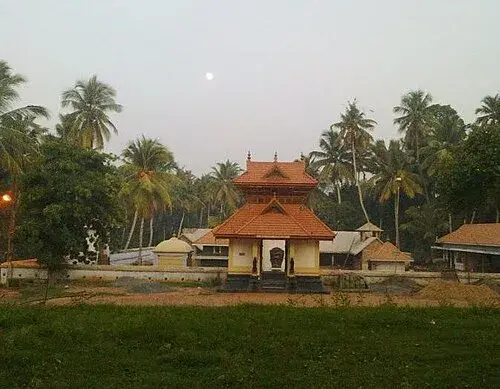 Photo: Muttathara · CC BY-SA 4.0