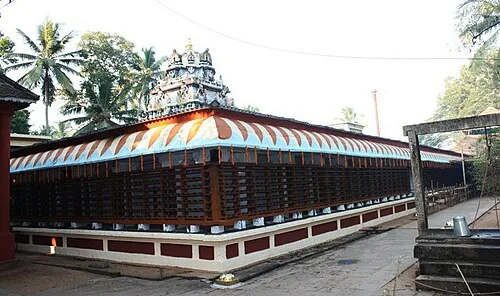
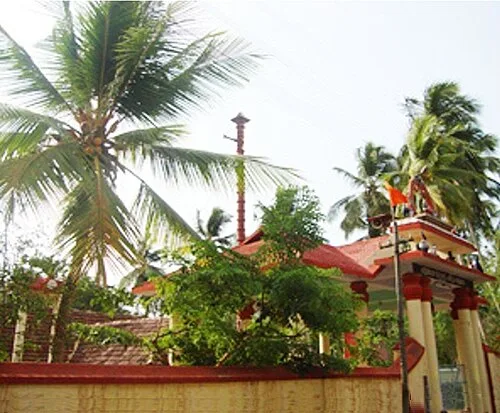
A Travancore Devaswom Shiva temple at Arayoor near the Tamil Nadu border, where the deity is lovingly called Arayoorappan.
At a glance
What: A temple of Shiva, with several attendant deities.
Where: Arayoor, in Chenkal village near Parassala.
When: Daily worship; the main festival is usually in February or March.
How: By road from Parassala or Neyyattinkara.
By whom: The Travancore Devaswom Board.
For whom: Devotees, festival lovers and travellers exploring the southern border villages.
The temple
Arayoor Mahadeva temple is one of the principal places of worship of its village and is classed as a major temple. Its closeness to the Tamil Nadu border places it in a landscape where two languages and two temple styles have long met. Local people speak of the deity with affection as Arayoorappan, the father of Arayoor.
The presiding deity
Shiva is worshipped here with Parvati, and a Malayalam description speaks of him in a meditative aspect. In Kerala temple thought the posture or mood attributed to a deity shapes the offerings and the manner of worship. A calm, meditating Shiva is approached with lamps, water and bilva leaves.
Attendant deities
The subsidiary shrines include Ganesha, Durga, Murugan, Nandikeshwara, Ayyappa, Bhootathan, Nagaraja and Yakshiyamma, and the Malayalam account also mentions Shasta and the nine planets in this connection. This broad company allows families to meet many needs in a single visit, from the removal of obstacles to the pacifying of planetary influences.
Guardians and local spirits
Bhootathan and Yakshiyamma belong to an older layer of southern worship, in which protective spirits guard land and family. They are honoured beside the pan-Indian deities. Such figures are common between Thiruvananthapuram and Kanniyakumari and are a reminder that village religion has its own history.
The serpent deities
Nagaraja's shrine reflects the old Kerala reverence for snakes as keepers of fertility, rain and family welfare. Offerings of milk and turmeric powder are customary on the monthly Ayilyam star. The custom also protected small groves where serpents and many other creatures could live.
Under the Devaswom Board
The temple is administered by the Travancore Devaswom Board, a statutory body that manages many temples of the former Travancore state. It appoints staff, fixes the rates of offerings and oversees accounts, while local advisory committees usually help to organise festivals. Receipts should be taken for all payments.
Daily timings
Published timings give opening at half past four in the morning with closure at half past ten, and an evening session from half past five to half past eight. Hours can be altered on festival days, during eclipses or by board order, so confirm before a long journey.
The flag hoisting
The annual festival, normally in February and March, opens with the thrikkodiyettu, the raising of the temple flag. From that moment the village is considered to be in festival, and by custom the days that follow are filled with special worship, music and community meals.
The procession
On the ninth day comes the ghoshayatra, a grand procession with decorations, percussion and crowds lining the roads. The festival is spoken of as one of the grandest in Neyyattinkara taluk. If you plan to watch, reach early, wear comfortable clothes and keep children close.
The arattu
The festival ends on the tenth day. In the evening, after a solemn ceremony, the flag is lowered and the deity is taken for arattu, a holy bath in the temple pond nearby. Devotees consider it auspicious to witness the immersion and to receive the sanctified water.
Cultural programmes
Temple festivals in the region double as village arts weeks, with devotional singing, dance, drama, recitals and sometimes older forms such as villadichan pattu, the bow song of south Travancore. The particular programme is announced each year by the festival committee.
Maha Shivaratri
The night of Shivaratri is observed with fasting, repeated bathing of the linga and vigil until dawn. In the neighbouring Kanniyakumari region, devotees also undertake the Sivalaya Ottam, walking and running between twelve Shiva temples while calling the names of Govinda and Gopala. That pilgrimage lies across the border but is part of the shared culture of the area.
Pradosham
Twice each lunar month the thirteenth day brings Pradosham, when evening worship of Shiva is thought especially fruitful. Temples hold additional pujas as the sun sets. For a visitor wishing to see devotion without festival crowds, a Pradosham evening is a good choice.
Visiting with respect
Remove footwear at the entrance, men remove shirts where required, and mobile phones should stay silent. Do not touch images or step on the steps of the sanctum. Photography inside Kerala temples is normally forbidden. Walk clockwise and do not cross the water outlet of the sanctum.
Getting there
Parassala railway station and bus stand are the closest transport points, and Neyyattinkara is also convenient. Autorickshaws serve the village roads. Thiruvananthapuram, with its airport, is about thirty kilometres to the north-west. Drivers should expect narrow lanes during the festival.
When to come
The festival season is the liveliest, and warm days make evenings pleasant. Monsoon months give quiet visits among green fields. Early morning worship at any time of year offers the calmest experience.
Nearby places
Parassala Mahadeva temple, the Chenkal Shivalinga temple, the Neyyattinkara Krishna temple and the churches of the Parassala area can be combined. Padmanabhapuram Palace across the border makes a longer outing.
Facilities
Village shops and tea stalls serve ordinary days; stalls multiply at festival time. Lodging and fuller services are at Parassala and Neyyattinkara.
The border country
Arayoor lies in a belt of coconut gardens, paddy fields, ponds and small hills where the old state of Travancore once ran unbroken to Kanniyakumari. The reorganisation of states in 1956 drew a line through that country, but kinship, trade and pilgrimage did not stop at it. Visitors hear Tamil and Malayalam side by side, and many families keep ties to temples on both banks of the boundary.
The temple pond
The pond used for the arattu is more than a ceremonial tank. Such ponds store rainwater, keep neighbouring wells filled and cool the air around the shrine. Bathers follow simple courtesies: no soap, no washing of clothes where it is forbidden and nothing thrown into the water. Depth is uneven and steps grow slippery with moss, so children should not be left near the edge.
What to carry
Bring small notes for the offering counter, a cloth for wrapping footwear or prasadam, drinking water and an umbrella during the rains. For festival evenings, arrange the return journey beforehand, because buses become crowded and autorickshaws may not be able to approach the temple until the procession has passed.