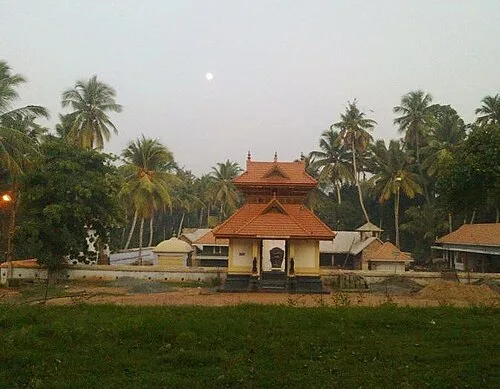
An old Shiva temple on the bank of the Neyyar at Amaravila, counted among Kerala's 108 Shiva shrines and known for ancestral rites in Karkidakam.
At a glance
What: A temple of Shiva worshipped as Rameswara, with Parvati.
Where: Amaravila, on the bank of the Neyyar next to Neyyattinkara town.
When: Daily worship; the annual festival falls in Dhanu, December to January.
How: By road or rail to Neyyattinkara and a short local ride.
By whom: Temple priests and the local management; confirm the administering body on site.
For whom: Devotees of Shiva, families performing ancestral rites and heritage travellers.
The temple
Amaravila Rameswaram is an old riverside shrine just outside Neyyattinkara. The presiding deity faces west. Ganapati has his place to the right of the sanctum. The combination of a quiet river bank, a compact temple and a strong tradition of rites for the dead gives it a character distinct from the busy town temples nearby.
The name
Local belief holds that Rama himself installed the image, and so the deity is called Rameswara, the lord of Rama. The better known Rameswaram on the island off Tamil Nadu carries the same story of Rama worshipping Shiva. Here the tradition links a village on the Neyyar to that great theme of the epic.
One of the 108
The temple is regarded as one of the 108 Shiva temples of Kerala, which tradition says were founded by the sage Parashurama. They are listed in a devotional hymn, the Shivalaya Stotram, which pious people recite. The list contains two places named Rameswaram: this one, in the far south, and another in Kollam town. A Malayalam account calls this the southernmost shrine in the list.
Parashurama in legend
Parashurama, counted an incarnation of Vishnu, is said to have thrown his axe into the sea and raised the land of Kerala, then to have settled it and established temples. The story is a founding myth. Archaeology and geology do not support the raising of land in this way, but the legend shows how communities connect their local shrines into one sacred landscape.
Two presences in one sanctum
An unusual arrangement is reported here: the Shivalinga faces east, while an image of Parvati faces west within the same sanctum. Descriptions elsewhere give the presiding deity's facing as west, so observe for yourself and ask the priest. The pairing expresses the inseparability of Shiva and his consort, a theme repeated in many Kerala temples.
The river
The Neyyar rises in the Agasthyamalai hills and flows south-west past Neyyattinkara to reach the sea near Poovar. Its dam upstream serves irrigation. For the temple the river is a sacred bathing place. Its level changes sharply with the monsoon and with releases from the dam, so the steps need care.
Ancestral rites
The temple is well known for pitru tarpanam, offerings to ancestors, performed by the river in the Malayalam month of Karkidakam, which falls in July and August. The new moon of that month, Karkidaka Vavu, draws people across Kerala to rivers and seashores. Families offer rice, sesame and water in memory of parents and forebears.
What the rite involves
Participants usually bathe, wear a wet cloth, sit before a priest and follow the words and gestures step by step, with darbha grass, sesame, rice balls and flowers. The offerings are then released at the water. Many observe a simple diet from the previous day. Visitors should watch from a distance and not photograph grieving families.
The December festival
The annual festival runs for ten days in the month of Dhanu and closes with the arattu, the ceremonial bath of the deity, on the day of the Thiruvathira star. Processions, music and cultural programmes accompany it. Because the Malayalam calendar is lunisolar in its festival reckoning, English dates shift each year.
Thiruvathira
Thiruvathira in Dhanu is dear to Shiva devotees, and especially to women, who traditionally fast, bathe early and perform the circle dance called Thiruvathirakali, with songs about Shiva and Parvati. The day is understood as celebrating Shiva's grace and the happiness of married life.
Shivaratri and Pongala
Maha Shivaratri, in February or March, is another major occasion, with night worship and offerings. A special feature reported here is Pongala for Parvati on that day. Pongala is the cooking of sweet rice in new pots over open hearths as a woman's offering, more often associated with Devi temples.
Offerings through the year
Common offerings at Kerala Shiva temples include water poured over the linga, milk, ghee, a garland of bilva leaves and the lamp. Archana, a recitation of names in the devotee's name and birth star, is widely requested. Ask at the counter which offerings are available and their present rates.
Architecture
The temple follows regional sacred design, with a sanctum, enclosure and the open spaces used for circumambulation. Kerala temples use sloping roofs suited to heavy rain. Published detail on the age of particular structures here is lacking, so claims of great antiquity should be understood as tradition unless inscriptions or surveys confirm them.
Visiting with respect
Men usually enter the inner enclosure bare-chested, and women wear saris, long skirts or churidars. Leave footwear and leather items outside. In Shiva temples the custom is not to cross the channel that carries water from the sanctum, so devotees turn back at that point. Follow the example of regular worshippers.
Getting there
Neyyattinkara railway station and bus stand are close by, and the temple is about a kilometre from the town in Amaravila. The national highway to Nagercoil passes through the area. Thiruvananthapuram city is about twenty kilometres north, with the nearest airport. Autorickshaws are easy to find.
When to come
Early morning is the finest time for the riverside. December to January combines the festival with mild weather. On the Karkidaka new moon, arrive very early, expect traffic control and follow police directions near the water. Heavy rain may restrict access to the ghat.
Nearby places
Aruvippuram, where Narayana Guru consecrated a Shiva image in 1888, lies up the same river. The Neyyattinkara Sree Krishna temple and the Chenkal Shivalinga temple are near, and Poovar's estuary is within easy driving distance.
Facilities
Shops, food and lodging are found in Neyyattinkara. Temporary arrangements for rites are set up in Karkidakam. Carry a change of clothes if you intend to bathe, and use no soap or plastic in the river.
For first-time visitors
If you have not seen a riverside rite before, come on an ordinary morning first. You will find the temple unhurried, learn the layout and see how the path leads down toward the water. Priests and older devotees are usually willing to explain when a ceremony may be booked and what to bring, provided you ask between rituals rather than during them.
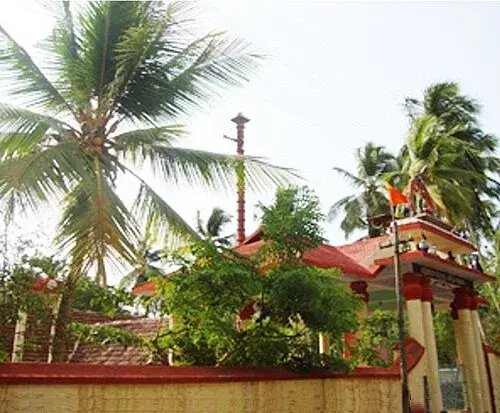 Photo: The original uploader was RajeshUnuppally at Malayalam Wikipedia. · CC BY-SA 3.0