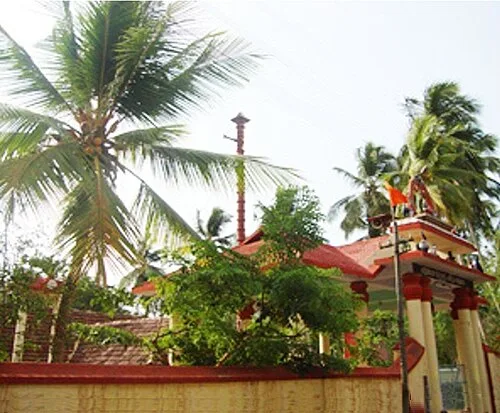
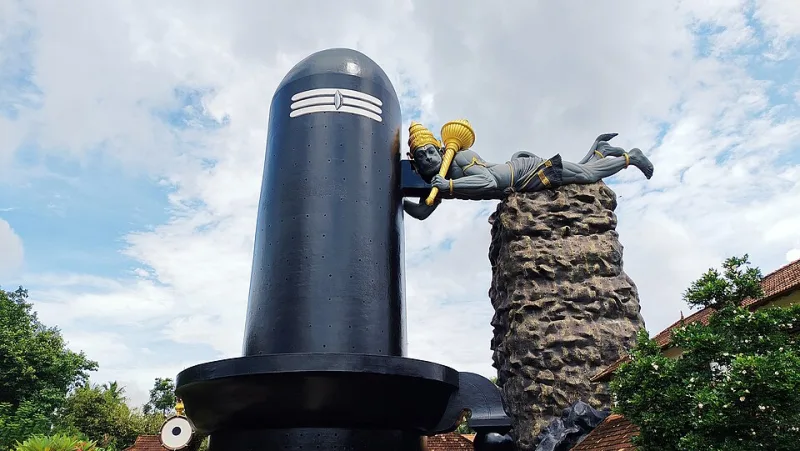
The riverside Shiva temple where Sree Narayana Guru consecrated a Shiva image in 1888, a turning point in Kerala's social reform.
At a glance
What: A Shiva temple of great importance in the social history of Kerala.
Where: Aruvippuram, beside the Neyyar river near Neyyattinkara.
When: Consecrated in 1888; Maha Shivaratri is also its anniversary.
How: Travel from Thiruvananthapuram to Neyyattinkara and continue by local bus or autorickshaw.
By whom: Consecrated by Sree Narayana Guru.
For whom: Devotees, followers of the Guru, students of history and respectful visitors.
About the temple
Aruvippuram is a village in the south of Thiruvananthapuram district whose name is known far beyond its size. Its Shiva temple stands near the Neyyar river, among rocks and greenery, and it is remembered above all for the man who installed its image. In 1888 Sree Narayana Guru consecrated a Shiva linga here, the first person who was not a Brahmin to perform such an act openly in Kerala society.
To understand why this mattered, one must recall the caste order of the time. Large communities, including the Ezhavas to which the Guru belonged, were kept out of many temples and even off certain roads. Consecrating a deity was held to be the exclusive right of priests of the highest caste. By taking a stone and installing it for worship, the Guru asserted that devotion and spiritual authority did not belong to any one group. The temple that grew around the act gave people a place where they could pray with dignity.
History
The consecration took place on a Shivaratri night, and the festival therefore marks both the great night of Shiva and the anniversary of the temple. News of the event spread quickly and drew criticism from defenders of old custom. A widely told reply attributes to the Guru the remark that he had consecrated an Ezhava Shiva, and not a Brahmin one. Historians and followers quote the saying to show his wit and his refusal to accept that the divine could be limited by birth.
The work begun here led to organisation. The Aruvippuram temple committee developed into the Sree Narayana Dharma Paripalana Yogam, known as the SNDP Yogam, formed in 1903, which campaigned for education, temple access and social rights, with the poet Kumaran Asan among its early leaders. The Guru went on to consecrate temples in many places and, as his thought developed, placed lamps, inscribed words and a mirror in some shrines to direct attention to knowledge and self understanding. His teaching of one caste, one religion and one God for humankind has become part of the moral vocabulary of the state.
Stories of the Guru at Aruvippuram
Before the consecration, the Guru had spent years in meditation and wandering, and this riverside was one of the places he chose for solitude. A rocky height nearby, Koduthooki Mala, has a cave where he is said to have rested and practised austerities. Local telling speaks of him living simply on what villagers brought, of people coming with sickness and quarrels, and of his insistence on cleanliness and honest conduct.
The best loved account of the night of 1888 describes the Guru entering the river, remaining under the water for a time and rising with a stone, which he held in meditation for hours before placing it on a seat of rock as dawn approached, while those present chanted the name of Shiva. Details differ among tellers. The central fact of the consecration is secure; the more wondrous elements belong to devotion.
Beliefs, misunderstandings and facts
Some visitors assume that this is an ancient temple with a long royal history. Its fame rests on a modern event, well within recorded time. Others suppose that the temple is only for members of one community. The whole point of its founding was openness, and respectful visitors are welcome, subject to the ordinary customs of worship.
Devotees believe that prayers offered here, especially on Shivaratri, bring blessing. Such belief is personal. The historical lesson, that a peaceful act can challenge an unjust rule, is open to everyone. Quotations attributed to the Guru circulate widely in changed forms; students should check them against reliable editions of his works.
The Guru's wider message
Sree Narayana Guru was born in the middle of the nineteenth century at Chempazhanthy and was learned in Malayalam, Sanskrit and Tamil. His writing ranges from hymns to Shiva to compact philosophical verse in the tradition of non duality, the view that one reality underlies all beings. What made him unusual was the way he joined that philosophy to everyday reform. He urged people to found schools, to give up costly and harmful customs, to avoid liquor, to keep themselves and their surroundings clean and to take up trades that would free them from dependence.
Aruvippuram shows the first public step of that programme. The Guru did not answer exclusion with violence or by asking permission. He created a place of worship and invited people to it. Later reform movements in Kerala, including the satyagraha at Vaikom in the 1920s for the right to walk on temple roads, belong to the same long struggle, and Mahatma Gandhi met the Guru at Sivagiri during that period. The Temple Entry Proclamation of Travancore in 1936 came some years after the Guru's death in 1928.
Questions visitors ask
Is this a monument or a working temple? It is a working temple, with daily worship, and the memorial character comes from its history. Visitors who are interested mainly in that history are welcome to look quietly, but should give way to people who have come to pray.
Can one meet a guide? There is no guarantee of a guide on any given day. Reading a short life of the Guru before arriving makes the visit far richer, and temple office staff or volunteers may point out the places associated with him. When is the atmosphere most memorable? Many would say the night of Shivaratri, with lamps, chanting and the river nearby, though an ordinary morning allows more room for reflection. Is there food or lodging? Do not count on either outside festival days; Neyyattinkara town has eating places, and the capital offers a wide choice of rooms.
Visiting
Wear modest clothing, remove footwear before entering the precinct and keep silence near the sanctum. Ask before photographing worshippers or the interior. The climb to the hill and cave involves rock steps that become slippery in rain, so wear footwear with grip for the path and carry water. Do not scratch rocks or leave litter, particularly near the river. Bathing in the Neyyar needs caution, as the current can strengthen quickly when the upstream dam releases water.
One to two hours is enough on an ordinary day. During Shivaratri the village is crowded for several days, with special buses, volunteers and meals; arrive early and fix a meeting point.
Around Aruvippuram
Neyyattinkara has a well known Sree Krishna temple. The Neyyar dam and wildlife area lie upstream, the coast at Vizhinjam and Kovalam is within easy reach, and Chempazhanthy, the Guru's birthplace north of the city, with Sivagiri at Varkala, where he rests, completes a journey through the places of his life.