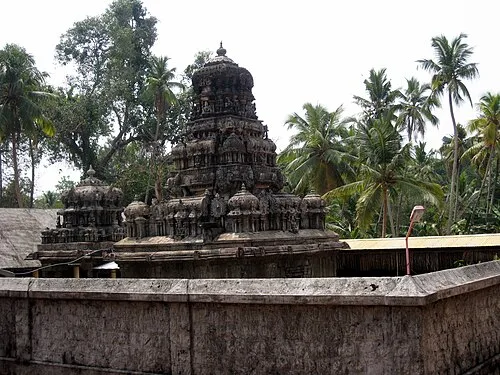
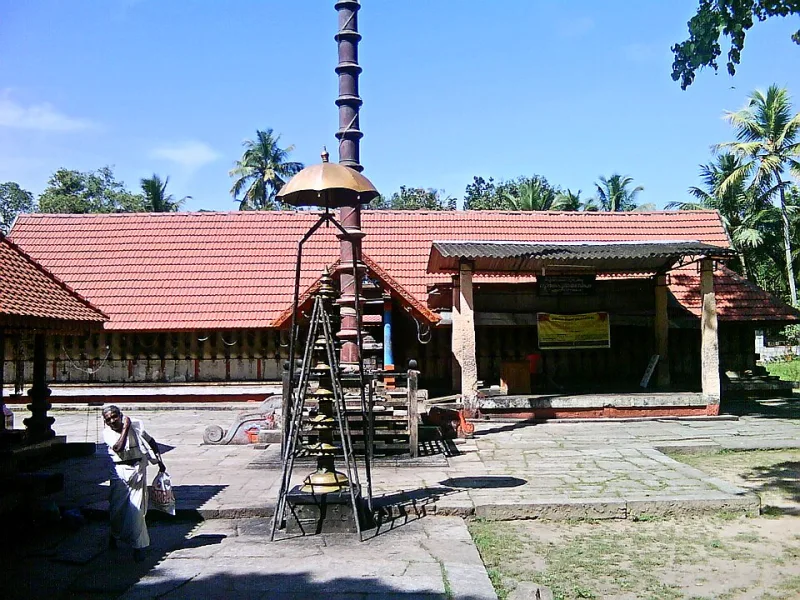
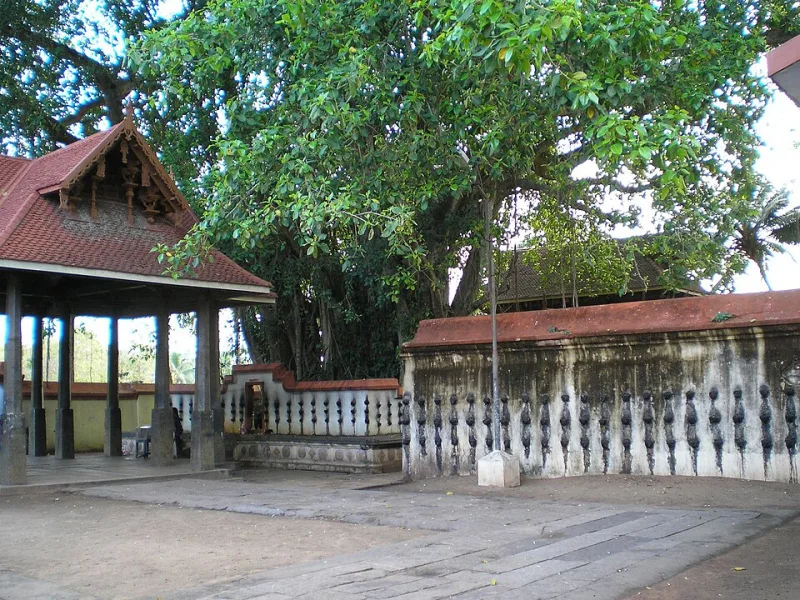
A goddess temple near Kallambalam where the deity is worshipped as Kannagi, with Kumbha Bharani and a Pongala in Medam as its chief occasions.
At a glance
What: A temple of the goddess as Kannagi.
Where: Near Kallambalam in the north of Thiruvananthapuram district.
When: Daily worship; Kumbha Bharani, and Pongala on the Uthram star in Medam.
How: By road from Kallambalam, Attingal or Varkala.
By whom: Temple management; confirm on site.
For whom: Devotees, women offering Pongala and students of the Kannagi tradition.
The temple
Changattu temple is a neighbourhood Bhagavathy shrine of the Kallambalam area. Descriptions name Kannagi, identified with Parvati, as the principal deity. Its yearly round includes a Bharani celebration and a Pongala that draws thousands of women, showing how large a following a modest village temple can have.
Who was Kannagi?
Kannagi is the heroine of the Tamil epic Silappadikaram, composed in the early centuries of the common era and ascribed to Ilango Adigal. A faithful wife, she saw her husband Kovalan wrongly executed for stealing a queen's anklet. She proved his innocence by breaking her own anklet before the Pandya king.
The burning of Madurai
Realising his injustice, the king fell dead. Kannagi, in her grief and anger, set Madurai ablaze. She then walked west into the hill country of the Cheras, where she ascended to heaven. The Chera king Senguttuvan is said to have raised a temple to her. Her story is thus claimed by Kerala as well as Tamil Nadu.
From heroine to goddess
Over centuries Kannagi came to be worshipped as a form of the mother goddess, sometimes merged with Bhagavathy or Bhadrakali. The meaning devotees draw is that truth and chastity carry a power before which even kings must bow. Women especially approach her for the protection of family.
Songs of the story
In south Kerala the tale is sung as thottam pattu or kovalan pattu during goddess festivals, most famously at Attukal, where the days of the festival follow the narrative. Local singers have their own versions, differing from the classical epic in names and episodes. Whether such singing is performed here should be asked locally.
Kumbha Bharani
The Bharani star in the month of Kumbham, usually February or March, is a great day in goddess temples. Special offerings, processions and art forms are common, and the shrine may stay open longer. Confirm the date, since it is fixed by the star and moves on the English calendar.
Medam Pongala
The Pongala at this temple falls on the Uthram star in Medam, in April or May. Women gather around the temple and cook sweet rice in new pots. It is the height of summer, so participants should carry drinking water, cover their heads and rest in shade when possible.
The meaning of Pongala
The word means to boil over. As the rice rises above the rim, devotees raise a ululation, taking it as a sign of blessing. The cook is her own priest while preparing the offering. This direct participation, open to women of every background, explains much of the rite's popularity.
Kallambalam
The town takes its name, according to a local account, from an old stone rest house, since kal means stone. Standing on the national highway, it joins Varkala to Attingal and Kilimanoor. It is the northern commercial centre of this part of the district and the natural starting point for the temple.
Stone rest houses
Wayside rest houses and stone load bearers once lined the roads of Kerala, built by benefactors so that walkers carrying head loads could pause and drink. A place name preserving one recalls a time when journeys to temples and markets were made on foot.
Neighbouring worship
The Kallambalam area also has the Kaduvayil Juma Masjid, the Navaikulam church and the temples of Navaikulam and Mullaramcode. A short drive shows how several communities live and worship side by side. Visitors are welcome to admire each respectfully and according to its own rules.
Navaikulam
Navaikulam, nearby, is known for the old Sankaranarayana temple, where Shiva and Vishnu are honoured in one form. Heritage travellers often pair it with Varkala. Adding Changattu gives the goddess her place in the same morning.
Offerings
Red flowers, garlands, lamps, vermilion, archana, kadumpayasam, a thick dark sweet, and at festivals Pongala, are the usual offerings to Bhagavathy. The temple counter will tell you what is currently offered and at what rate.
Days of the week
Tuesdays and Fridays are favoured for goddess worship, when evening lamps are lit in larger numbers. The Navaratri season in September or October brings special observances and the initiation of children into writing at many temples.
What is not recorded
Published information gives the deity, festivals and access, but little about founding, architecture or management. No claim of great antiquity is made here. Residents who know how the shrine began are invited to share the account with its source.
Belief and fact
The Kannagi epic is literature of the first rank; its events are not established history. The practice of worshipping her is a living fact. A visit lets one see how an old story continues to shape festivals and personal devotion.
Visiting with respect
Wear modest dress, remove footwear and avoid photographs inside or of women cooking without consent. Keep fire safety in mind on Pongala day, and follow volunteers.
Getting there
Kallambalam is on the highway about thirty-six kilometres north of the capital, with frequent buses. Varkala Sivagiri railway station is about fifteen kilometres off and the airport about thirty-five. Autorickshaws cover the last three kilometres.
When to come
Come in the morning or evening. Festival months are warm; October to January is comfortable. Roads are crowded on Pongala day.
Nearby places
Navaikulam temple, Varkala cliff and Sivagiri, Attingal's temples and Kilimanoor Palace can be combined.
Facilities
Kallambalam has shops, eating places and banks. No entry fee applies.
Help complete this page
Send the exact position, festival programme and photographs using the links on this page.
Reading the epic first
Even a short summary of the Silappadikaram enriches the visit. Note how the poem moves through the three Tamil kingdoms, how it treats music, dance and city life, and how its heroine grows from a shy bride into a figure who judges a king. Translations in English and Malayalam are widely available in libraries.
Safety on Pongala day
Thousands of small fires in April heat call for care: keep synthetic clothing away, store spare wood at a distance, watch children and never leave a hearth burning when you depart.
In brief
Ask at Kallambalam for the shortest road.