An ancient temple of four-armed Vishnu worshipped as Krishna at Keezhperoor, tied by tradition to the Ay and Venad royal houses, with a circular sanctum and old stone carving.
At a glance
What: A temple of Vishnu in the form of Krishna.
Where: Keezhperoor village, Chirayinkeezhu taluk.
When: Daily worship; confirm festival dates locally.
How: By road from Attingal or Kilimanoor.
By whom: A local Nair Service Society unit, which took over management and led renovation.
For whom: Devotees and anyone interested in the early history of south Kerala.
The temple
Thirupalkadal, the sacred ocean of milk, is the name of this old shrine in the countryside north of Attingal. It is counted among the oldest temples of the district. The setting is rural, and the remains within the granite compound walls speak of a time when the place carried greater political weight than its present quiet suggests.
The image
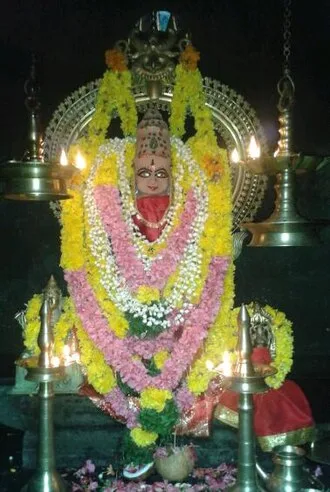
The central image is a standing Vishnu with four arms, holding the conch Panchajanya, the discus Sudarshana, the mace Kaumodaki and a lotus with a garland of holy basil. He is worshipped as Krishna. The old title Thirupalkadal Bhattarakar uses an honorific found in early inscriptions for revered deities.
The ocean of milk
In Puranic imagery Vishnu rests on the serpent Ananta upon an ocean of milk, from which the gods once churned the nectar of immortality. A temple bearing that name presents itself as an earthly likeness of Vishnu's own abode. The great Padmanabhaswamy temple in the capital expresses a related image of the reclining lord.
The Ay kingdom
The deity is described as the family god of the Ay dynasty, which ruled the far south in early historical times with centres including Vizhinjam. The temple is spoken of as the Ays' ancestral shrine, with Keezhperoor as a royal seat. These statements come from temple and local tradition, supported in part by the family names that continued in later royal houses.
From Ays to Venad
Accounts say a line called the Keezhperoor Swaroopam arose from the joining of the Chera house of Mahodayapuram with the Ays, and that it developed into Venad and in time Travancore. Rulers of Travancore did bear Keezhperoor among their house names. Historians continue to discuss how the early dynasties were connected.
Renovation in the ninth century
The temple is said to have been renovated in the ninth century by a Venad ruler, Vallabhan Kotha. Some also believe that the Kollam Era, the Malayalam calendar counted from 825, began with this renovation. There are several competing explanations of that era's origin, and none is universally accepted.
Kulashekhara Alvar
Tradition holds that Kulashekhara Alvar, a king and poet counted seventh among the twelve Vaishnava saint singers, renovated the temple. His Tamil hymns and Sanskrit Mukundamala are treasured. The shrine is not one of the 108 Divya Desams sung by the Alvars, though it appears in lists of other esteemed temples.
Management in 1121 or so
An arrangement is recorded for the twelfth century, in Malayalam year 343, when Vira Udaya Marthanda Varma Tiruvadi entrusted the temple to a council of trustees made up of Brahmins and Nair chiefs in the proportion of eight to two. He also fixed spending on the daily offering, worship and the yearly festival.
Decline and revival
In the twentieth century changes in land ownership after Independence cut the temple's income, and worship lapsed. A court order of 1965 is mentioned in connection with the transfer of management, and in the 1980s the local Nair Service Society unit obtained ownership and began renovation. The story is typical of many endowed temples of the period.
The circular sanctum
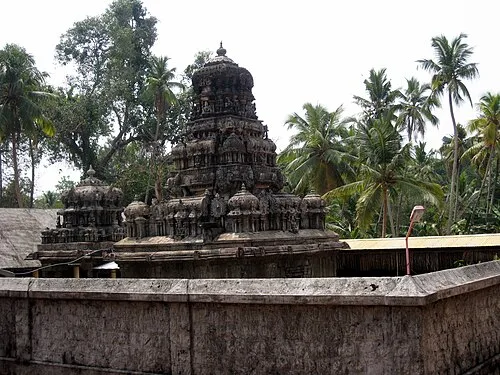
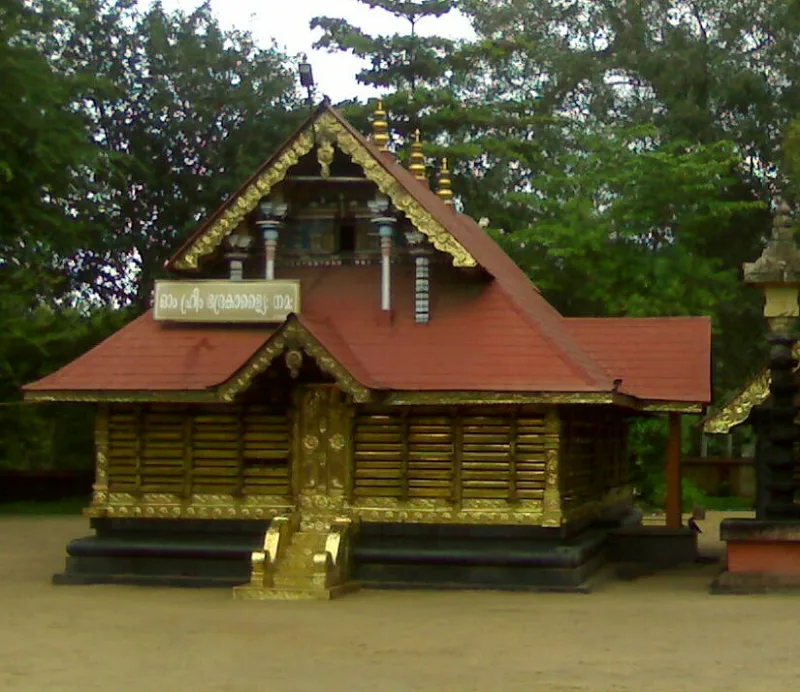
The sanctum is round, roofed with copper and surrounded by an inner passage. Its roof is described as framed by thirty-six rafters set in twelve wooden sections, read as the twelve signs of the zodiac; three times thirty-six gives the sacred number 108. Figures of Brahma and Shiva appear on the outer wall.
The stone steps
Six granite steps lead up to the sanctum door. One balustrade ends in a lion's head with a long curled tongue and carries Shiva with Parvati on his lap, along with small figures of Ganesha, Murugan and a resting Nandi. The other shows four-armed Vishnu with Sridevi and Bhudevi. Look closely in good light.
Other structures
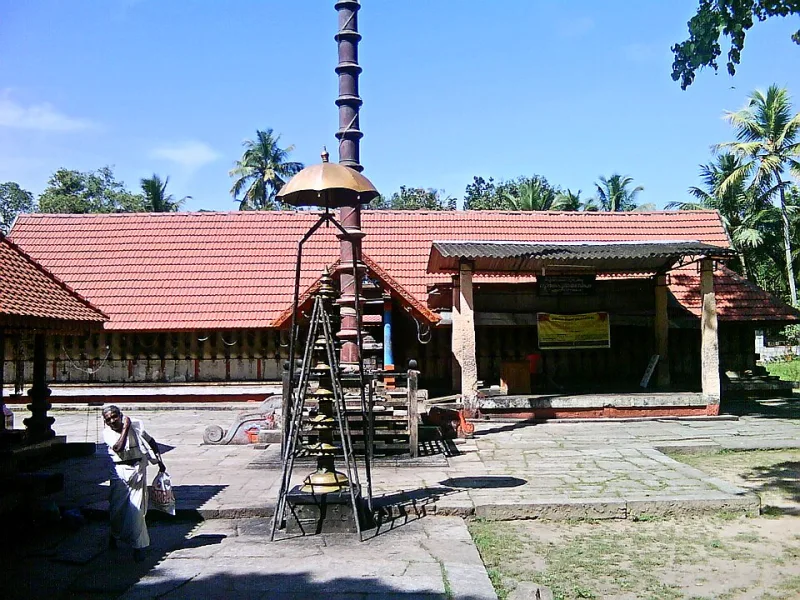
Visitors can see a long granite base on either side of the eastern entrance, the principal sacrificial stone, a large elephant shelter in front, and the pillars of the namaskara mandapam with stone carving. A modest temple theatre once stood to one side, and the gateway house over the main stone has long since fallen.
Murals
Paintings of Krishna's childhood and youthful play once adorned the sanctum walls. Murals in Kerala temples are painted with natural colours on prepared plaster, and they suffer from damp, smoke and well-meant repainting. If traces remain, view them without flash and without touching.
Worship today
Daily rites continue in the usual Kerala manner. Krishna's birth, Ashtami Rohini, in August or September, is a natural high point for a Krishna shrine, as are the readings of the Bhagavata over seven days. Offerings such as butter, milk payasam and tulsi garlands are customary.
Visiting with respect
Follow the dress code, remove footwear and keep phones silent. Do not photograph the sanctum. The old fabric is fragile: do not sit on carved stones, lean on pillars or pour oil on sculpture. Offer support for conservation through official channels.
Getting there
Attingal and Kilimanoor are the nearest towns with frequent buses; take an autorickshaw to Keezhperoor. Chirayinkeezhu and Varkala Sivagiri are useful railway stations. Thiruvananthapuram's airport is about forty kilometres to the south. Village roads are narrow.
When to come
Morning worship offers calm and clear light on the carvings. November to February is comfortable. During the monsoon the countryside is green but the old stones are slippery. Telephone ahead through local contacts if you are travelling far.
Nearby places
Attingal's temples and palace precinct, Kilimanoor Palace associated with the painter Raja Ravi Varma, the Sarkara Devi temple and Varkala make a heritage circuit.
Facilities
Simple shops are near, with meals and lodging in Attingal and Varkala. There is no entry charge.
For students of history
The temple rewards those who separate three layers: what is carved and built, what is written in dated records, and what is told. Each is valuable, and each answers different questions about the past.
Visiting with children
Children enjoy hunting for the lion, the bull and the elephant-headed god among the carvings. Set one rule beforehand: look with the eyes and not with the hands.