About St. Xavier's Church, Peyad
A Latin Catholic church at Peyad with roots in the Neyyattinkara mission and Belgian Carmelite missionaries, known for a mix of Greek and Roman styles and a bell from Belgium.
At a glance
What: A Roman Catholic parish church dedicated to Saint Francis Xavier.
Where: Peyad, a village on the eastern side of Thiruvananthapuram city.
When: Open for worship through the year; the saint's feast day is 3 December.
How: By road from the city by way of Thirumala or Malayinkeezhu.
By whom: A parish of the Latin Catholic Diocese of Neyyattinkara.
For whom: Parishioners, pilgrims and anyone interested in mission history and church building.
The church
St. Xavier's at Peyad is a Latin-rite church of the Diocese of Neyyattinkara. The diocese was formed on 5 November 1996, and before that date the parish was under the Archdiocese of Trivandrum. The community's memory, however, reaches back well before independence, to the years when missionaries were building small stations in what was then thinly connected countryside.
The Neyyattinkara mission
Parish history traces the story to Father John Damascene, remembered as the father of the Neyyattinkara mission, which dates from 1901. He established a mission at Kundamanbhagam, near the Karamana river, which was attached to the parish of Palayam in the city. Kundamanbhagam is close to Peyad, and the two names belong to one chapter of local church life.
The Carmelites
Further work by two Discalced Carmelite priests, Father Gregory and Father Pascasius, led to the start of church construction at Kundamanbhagam in 1904. Carmelite missionaries from the Flemish and Belgian province helped the effort. Carmelites had directed Catholic missions in much of southern Kerala for generations, and Belgian members of the order are prominent in the records of this region.
A bishop's advice
Records cited in the parish account say that Bishop Aloysius Maria Benziger, then Bishop of Quilon, visited the Kundamanbhagam mission. On his suggestion the missionaries rebuilt the church of Saint Francis Xavier at Peyad. Benziger, a Swiss-born Carmelite, headed a diocese that at that time included the Trivandrum area, and he travelled widely through its villages.
The building
The rebuilt church combines elements described as Greek and Roman, which in plain terms suggests classical features such as columns, pediments and rounded arches. The missionaries chose an engineer from Belgium, who worked with a local contractor remembered as Kunju. The priest's residence was added during the time of Father Brocard, also a Carmelite.
The bell
A prized possession is a church bell brought from Belgium by Father Pascasius. Parish tradition says that it is one of forty-four bells of the same make. The statement about the number is repeated here as the parish records it; it has not been checked against the foundry's own lists, which were not available.
A wider parish
In early days the church at Peyad functioned as the head of a partial district that included Kundamanbhagam. Mission churches of this period often served scattered families over a broad area, with a priest travelling between chapels. The feast of Saint Sebastian drew many believers even when the village was considered remote.
Saint Francis Xavier
Francis Xavier was born in Navarre in 1506, helped Ignatius of Loyola found the Society of Jesus, and reached Goa in 1542. He worked among fishing communities of the far south, including parts of southern Travancore, before travelling to South East Asia and Japan. He died in 1552 on an island off the coast of China. His body rests in Goa.
Saint Sebastian
Sebastian, an early Roman martyr whose feast is on 20 January, is among the most popular saints in Kerala. He is traditionally invoked against epidemic disease, which gave his feast special weight in times when cholera and smallpox swept villages. The attachment of believers to his celebration at this mission is part of that wider pattern.
The diocesan era
The Neyyattinkara diocese covers the southern inland taluks of the district. Its creation brought bishop, clergy and institutions closer to rural parishes. Peyad today is a fast growing suburb, and its church serves families whose lives are tied to the city as much as to the land.
Worship and festivals
Sunday and weekday Masses, novenas, catechism and parish associations make up the regular round. The patron's feast around 3 December and the celebration of Saint Sebastian in January are the times when a visitor is most likely to see processions and lights. Confirm the dates each year, as parishes fix their programmes to suit weekends.
Visiting with respect
Dress modestly, speak softly and avoid walking near the sanctuary during prayer. Ask a parishioner or the priest before photographing the interior or trying to see the bell, which may be in a tower that is not open to visitors. Offerings are voluntary.
Getting there
Peyad lies about ten kilometres from the centre of Thiruvananthapuram on routes running east toward Kattakada. Buses from the East Fort and Thampanoor terminals serve the area. Thiruvananthapuram Central is the nearest main station and the city airport is the nearest airport. The map position marks Peyad village, so ask locally for the church gate.
Nearby places
Malayinkeezhu, with its old Sree Krishna temple, is close by. The road continues toward Kattakada and the Neyyar Dam area, with its reservoir and forest setting. Back toward the city are Thirumala and the Karamana river, whose banks gave the earlier mission station its home.
When to come
November to February is comfortable. The feast season in early December makes the visit lively. Rain is frequent from June to July and again in October. Weekday mornings after Mass are good for a calm look at the building.
Facilities
Village shops, eating places and public transport are available around Peyad junction, and the city's hotels and hospitals are not far. There is no ticket or entry fee. Parking is easier outside feast days.
Carmelites in Kerala
The Discalced Carmelites arrived in Kerala in the seventeenth century, sent from Rome at a time of deep division among local Christians. Over the following centuries they served bishoprics from Verapoly to Quilon, founded seminaries, presses and schools, and encouraged Indian religious congregations. The two priests remembered at Peyad belong to the later phase of this long presence, when members from Belgium took charge of southern missions.
Reading the church
A visitor can learn much by looking carefully. Compare the façade with the side walls, which may show different periods of work. Notice the height of the nave, the shape of the windows and any old tombstones or tablets. Photographs hung in the parish office or hall sometimes record earlier buildings. Ask an older parishioner, with courtesy, what they remember.
Keeping the memory
Dates and names in parish histories rest on registers, letters and the recollections of families. If your relatives preserved an old photograph, a feast notice or a story about the mission, sharing it with the parish helps to keep the record accurate for those who come after.
Old church and new
A photograph published as the front elevation of this church shows a modern curved building with a slender tower. The classical features recorded in the parish history may therefore belong to an earlier structure that has since been rebuilt or replaced. Ask at the parish which parts, including the Belgian bell, survive from the mission period.
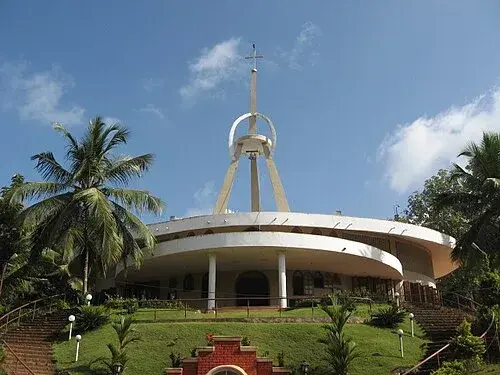 Photo: Justinroy · Public domain