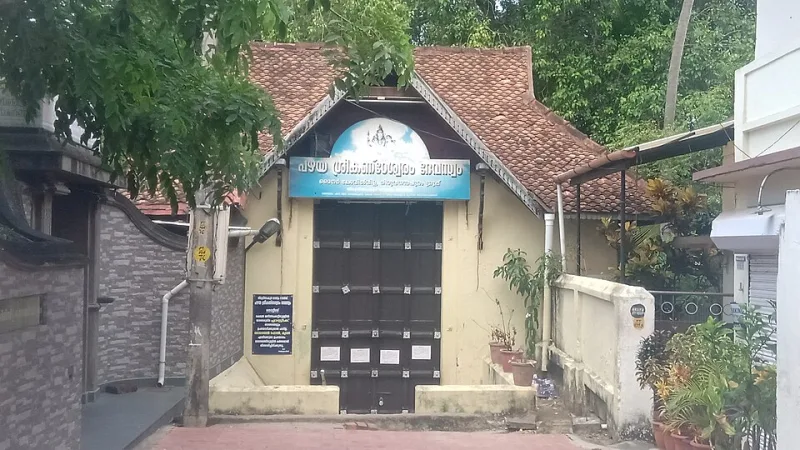
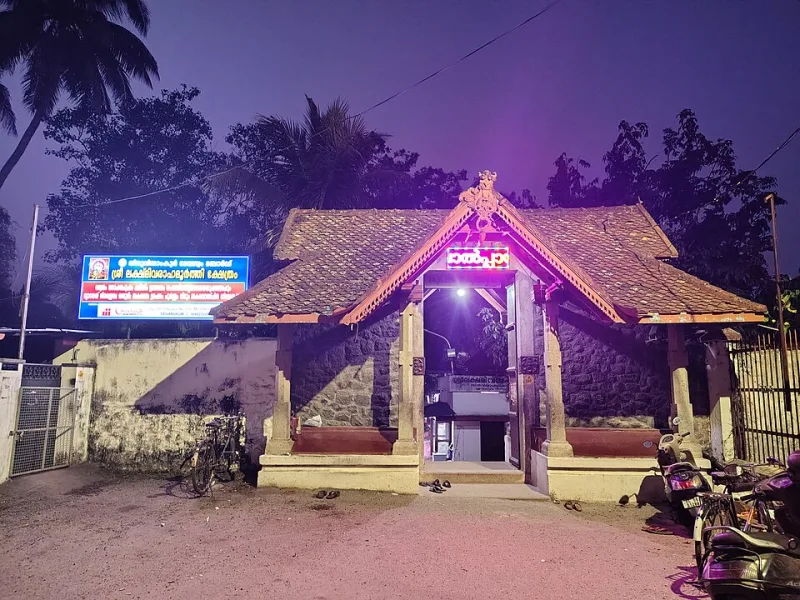
The city's best loved Ganesha temple at East Fort, maintained by the army and famous for the offering of breaking coconuts.
At a glance
What: A busy temple dedicated to Ganesha, the remover of obstacles.
Where: East Fort, close to Sree Padmanabhaswamy Temple.
When: Open daily in morning and evening sessions.
How: A short walk or autorickshaw ride from Thampanoor.
By whom: The idol was cared for by the soldiers of the Travancore Nair Brigade; the temple is maintained today by the Indian Army.
For whom: Devotees, travellers seeking a good beginning and visitors who observe custom.
About the temple
Stand at East Fort for a few minutes and you will hear it: the sharp crack of coconuts on stone. At the Pazhavangadi Maha Ganapathy Temple, in the heart of old Thiruvananthapuram, this is the favourite way to ask the elephant headed god to clear a path. Students before examinations, drivers with new vehicles, travellers, traders and office workers stop by throughout the day.
The principal image shows Ganapathi seated, with the right leg folded, a posture devotees point out to newcomers. Around the temple, sculptures display thirty two forms of Ganesha, a gallery that rewards patient looking. Shrines to Dharma Sastha, Durga and the serpent deities are also present. The temple is small compared with its famous neighbour, but its popularity makes it one of the liveliest corners of the city.
History
The story is a soldier's story. The original idol was in the care of the Nair Brigade, the army of Travancore, while the headquarters was at Padmanabhapuram, the old capital in the south. When the capital and the troops moved to Thiruvananthapuram, the soldiers brought their deity with them and installed it here, and the present temple grew from that installation. The Hanuman temple at Palayam in the same city has a similar origin among the cavalry of the brigade.
After the Travancore forces were integrated with the Indian Army in the years following Independence, responsibility for the temple passed to the army, which continues to maintain it. A temple run by a military unit is unusual and is a living reminder of the former state forces.
Stories of Ganapathi
The most familiar account of the god's birth says that Parvati formed a boy and asked him to guard her door. Not knowing him, Shiva fought him and struck off his head, and then, to console the mother, restored him with the head of an elephant and declared that he should be honoured before all others. This is why worship, journeys and new undertakings traditionally begin with Ganapathi.
Another much loved story tells of a contest between Ganesha and his brother to circle the world. While Subrahmanya set off on his peacock, Ganesha walked around his parents, saying that they were his world, and won. Parents repeat it to teach respect and quick thought.
Offerings and festivals
The chief offering is the breaking of coconuts, understood as breaking the ego and the obstacle together. Ganapathi homam, a fire ritual, and offerings of sweets such as appam and modakam, said to be dear to the god, are also performed. Vinayaka Chaturthi, usually in August or September, is the great festival, along with the monthly Sankashti days, and special worship takes place on Thiruvonam, Deepavali, Vijayadashami and Vishu.
Beliefs, rumours and facts
Devotees hold that a coconut that breaks cleanly is a good sign. Treat such readings as custom, not prophecy; a coconut that does not split fully is simply offered again if one wishes. No one outside the official counter can sell a special blessing, and visitors should beware of anyone who suggests otherwise. Claims that a particular hour guarantees results have no basis.
A day at the temple
The rhythm of the place follows the city. Early in the morning the first worshippers arrive for darshan and the fire offering to Ganapathi, performed to remove obstacles before the day's work. By the office hours, a steady line of people stop for a few minutes each, many carrying a coconut bought from a nearby counter. There is a lull around midday, when the shrine closes for a time, and the flow returns in the evening as lamps are lit and commuters head for buses at East Fort.
A visitor can simply watch from the side. Notice how a worshipper holds the coconut, often touching it to the forehead or circling it while thinking of a wish, before dashing it hard on the stone set aside for the purpose. The white kernel and water scattering is understood as purity revealed when the hard shell of pride breaks. Children are often invited to try, with a parent guiding the arm.
The forms of Ganesha
The thirty two forms shown in the temple's sculpture come from a traditional list found in devotional literature, which describes the god as a child, a youth, a giver of devotion, a hero with weapons, a dancer and in many other moods, with differing numbers of arms and objects in his hands. Recurring emblems include the broken tusk, the goad, the noose, a bowl of sweets and sometimes sugarcane or fruit. Looking for these details is an excellent game for young visitors and a quick lesson in how Indian art tells stories. A broken tusk, according to one well known legend, was used by Ganesha as a pen when he took down the Mahabharata from the sage Vyasa.
Questions visitors ask
Do I need to book to break a coconut? Usually one can simply buy one and offer it, while special poojas are booked at the counter. May visitors of other faiths come? Temple entry in Kerala follows the custom of each temple; ask politely at the entrance and respect the answer. Is it suitable for a short stopover? Very much so, since the railway station is close, but allow for security and queues if you have a train to catch.
Visiting
Men remove shirts before entering the inner area, and women wear traditional or modest dress. Footwear is left outside. Be careful where coconuts are being broken, since fragments fly and the ground can be wet. Traffic around East Fort is heavy: use crossings and keep hold of children. Security checks may apply, and photography inside is generally not permitted.
Half an hour is usually enough. Early morning is calmest. On festival days, expect long queues spreading to the street.
Around East Fort
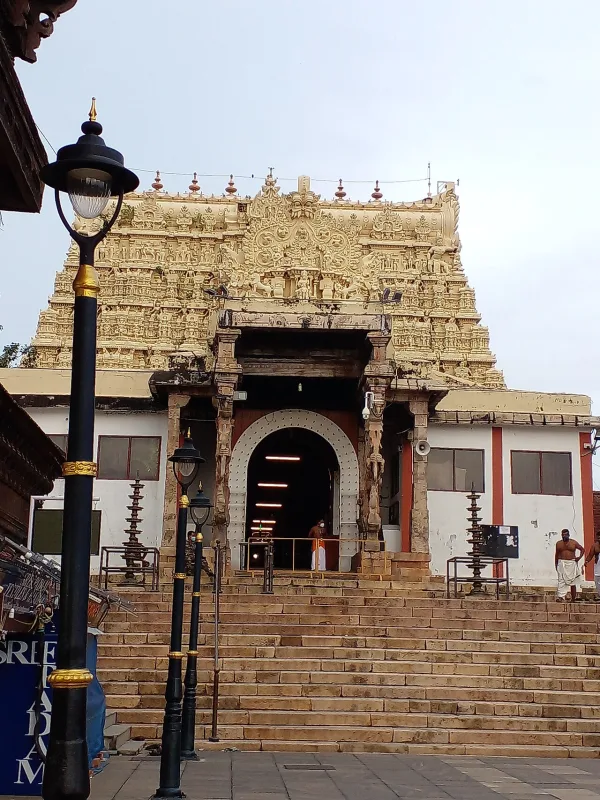
This temple makes a natural first stop before Sree Padmanabhaswamy Temple, whose gopuram is a short walk away. The Kuthiramalika Palace Museum, the temple tank, the historic gates of the fort and the Chalai bazaar, one of the oldest markets of the city, are all nearby. Vegetarian eating houses around East Fort serve breakfast from early hours.
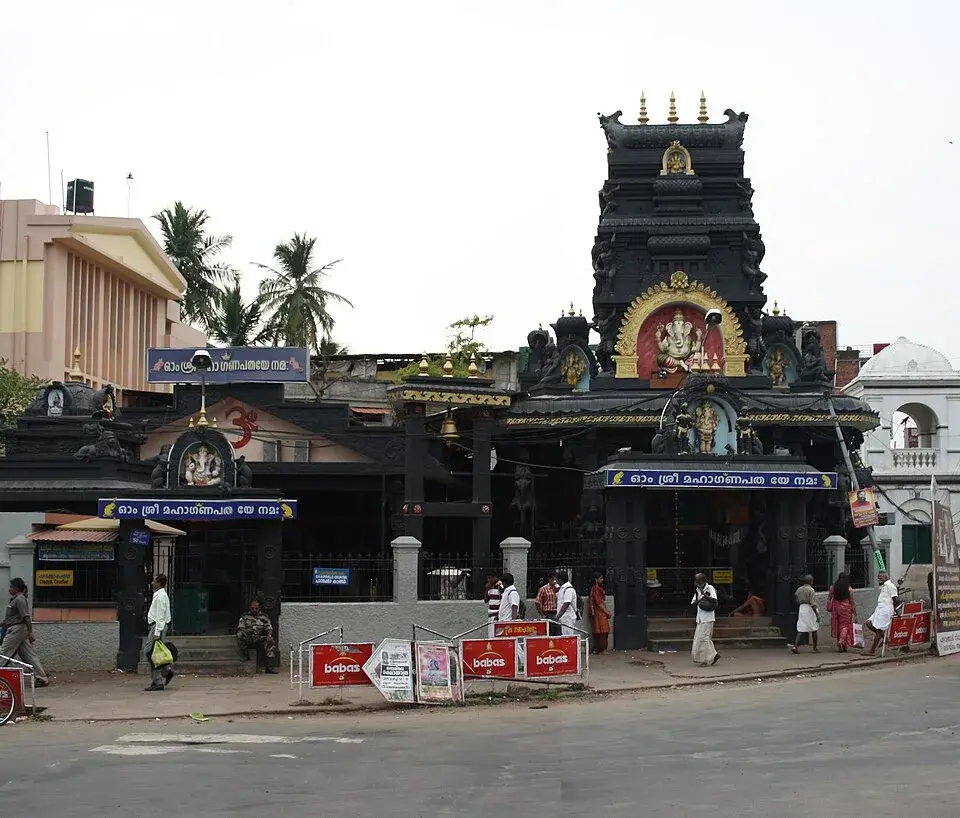 Photo: Jithindop · CC BY-SA 3.0