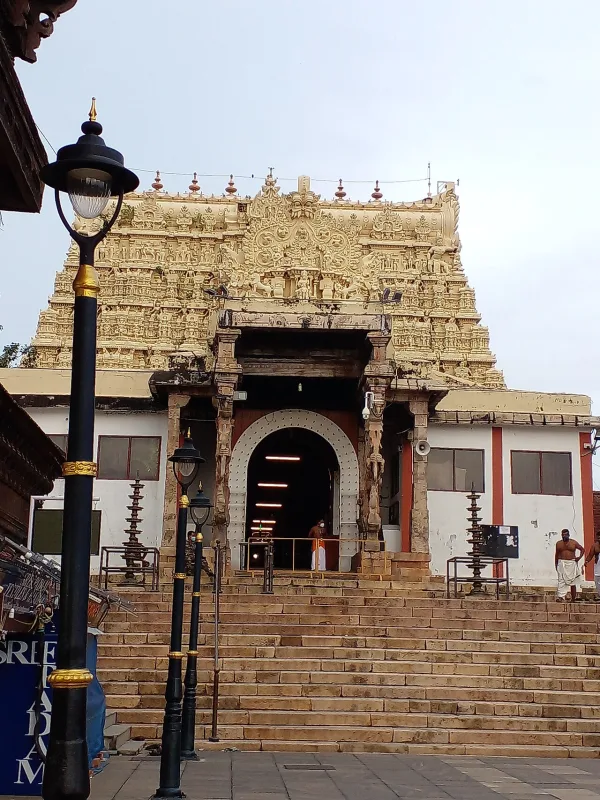
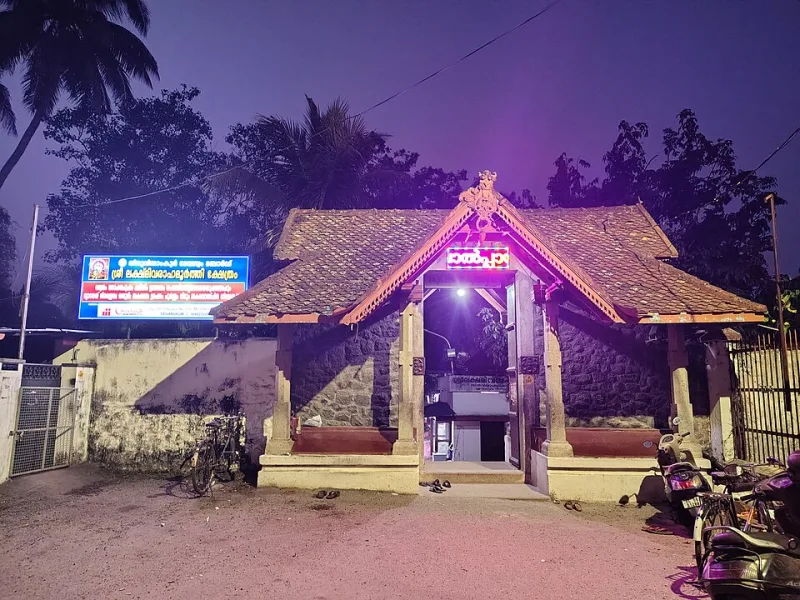
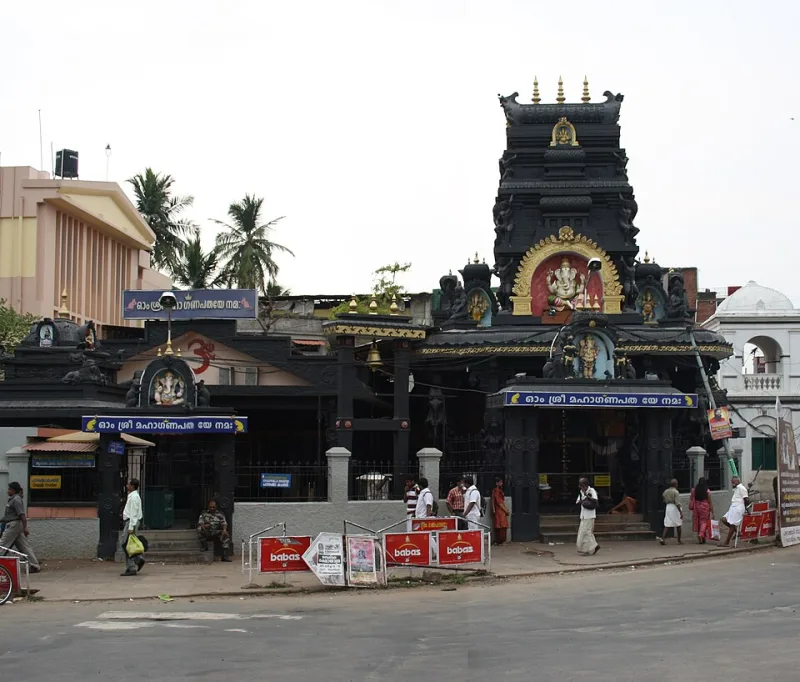
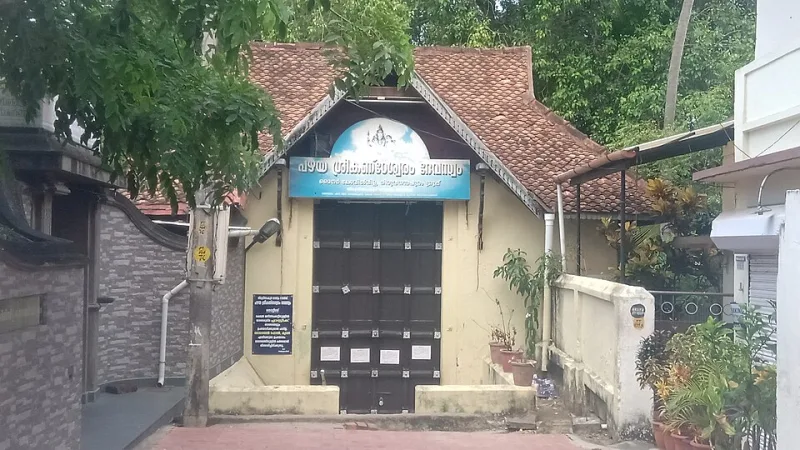
A Tamil Vaishnava temple of 1898, a minute's walk from Padmanabhaswamy, following its own priestly tradition.
At a glance
What: A temple to Vishnu as Venkatachalapathy, in the Sri Vaishnava tradition of Tamil country.
Where: Beside the great temple complex in the Fort area of Thiruvananthapuram.
When: Built in 1898.
How: Walk from the southern gate of Sree Padmanabhaswamy Temple.
By whom: Associated with the family of Sri Ranga Iyengar of Veeravanallur, with the deity installed by a head of the Vaishnava monastic line.
For whom: Devotees of Vishnu and visitors curious about the Tamil heritage of the city.
About the temple
Most visitors to the Fort area have eyes only for the towering gateway of Sree Padmanabhaswamy. A minute away stands a much smaller shrine with a different personality. Known variously as Srinivasar Kovil, Perumal Kovil, Iyengar Kovil and Desikar Sannidhi, the Sri Venkatachalapathy Temple serves a Sri Vaishnava tradition brought from the Tamil region.
Its building announces the difference. There is no towering gopuram, and the sanctum lacks the sloping tiled or copper roof and the elaborate carving expected in a Kerala sreekovil. Instead there is a flat terraced structure in the Tamil domestic temple manner. Worship also differs: while Kerala temples generally follow the Namboodiri style of ritual, here the daily service follows the Pancharatra system according to the Padma Samhita, observed in the Vadakalai manner.
The deities
The principal image is Venkatachalapathy, the Lord of the Venkata hill, beloved at Tirupati. In the sanctum with him are two forms of the goddess, Alamelu Mangai Thayar and Padmasini Thayar. Other shrines honour Navaneetha Krishna, also worshipped as Santhana Gopala, the child who blesses families with children, and Garuda, the eagle mount of Vishnu, affectionately called Periya Thiruvadi. Vishvaksena, who is regarded as the attendant and commander of the Lord's host, has his place too.
A particularly interesting shrine honours the Alvar saint Kulasekhara, who is remembered as a king who once ruled over this western land and gave himself to the devotion of Vishnu. Alongside him are Nammalvar, Thirumangai Alvar and the great teacher Ramanuja. Seeing them together is a compact lesson in the history of devotion in South India.
History and the story of the image
The account of the temple begins in a pond. Sri Ranga Iyengar of Veeravanallur, in the Tirunelveli region, is said to have seen the image in a pond near his house about a century or more ago. The temple was built in 1898, and the deity was installed by Sri Ranganatha Satagopa Yatindra Mahadesikan, the fortieth Azhagiya Singar, the title borne by the head of a respected Vaishnava monastery. According to his instruction, the eldest son of the Iyengar family was to serve as chief priest and manage the temple, and the account records that this arrangement continued for three generations.
Discoveries of images in water form a recurring theme in temple histories, often explaining how an icon once hidden for safety, or forgotten, returned to worship.
The Alvars and their songs
The twelve Alvars were poet saints who sang of Vishnu in Tamil more than a thousand years ago. Their hymns, gathered as the Nalayira Divya Prabandham, the four thousand divine verses, are recited in Sri Vaishnava temples and homes. Kulasekhara's verses express a longing so humble that he wishes to be born as a bird, a fish or even a stone step on the sacred hill, if only he may remain near the Lord. The step before many Vishnu sanctums is named Kulasekhara padi in memory of that wish. Ramanuja, living around the eleventh and twelfth centuries, gave this devotion a systematic philosophy and widened access to it.
Festivals
Most of the major Vaishnava festivals are observed. Vaikunta Ekadasi, in December or January, when devotees look forward to passing through the gate that symbolises heaven, is especially significant. The month of Purattasi, in September and October, is cherished by devotees of Venkatesa, with Saturdays drawing particular attention, and the birth stars of the Alvars and teachers are remembered through the year.
Beliefs, confusion and facts
Visitors sometimes mistake this shrine for a branch of the neighbouring Padmanabhaswamy temple. It is a distinct institution with its own tradition. Others expect an ancient monument because of the surroundings; the building dates to the end of the nineteenth century. Devotees believe that prayer at Santhana Gopala's shrine blesses couples who long for children. Such prayer is a source of comfort and does not take the place of medical advice. A temple of a similar name near Thuraiyur in Tamil Nadu is separate and unconnected with this one.
Two traditions side by side
The Sri Vaishnava community divides broadly into the Vadakalai, or northern, and Thenkalai, or southern, schools, which share a love of Vishnu and of the Alvars but differ on points of theology and custom, including the shape of the sacred mark worn on the forehead. A visitor may notice that mark on the images and priests here. Pancharatra, the ritual system followed, is a body of texts describing how images are to be installed and served as living royal guests: awakened, bathed, dressed, fed, honoured and put to rest. Seeing it practised a few steps from a great Kerala temple shows how the capital of Travancore welcomed scholars, cooks, musicians, officials and priests from the Tamil country, who brought their own forms of devotion and became part of the city.
Visiting
Dress modestly in traditional style where possible, leave footwear outside and ask about any area reserved for priests. Photography of the images is normally not permitted. Because the temple is small, wait patiently if worship is in progress, and receive offerings in the manner shown by the priest. Hours are likely to differ from those of the larger neighbour, so check on arrival. Bags and phones may be restricted by security arrangements in the Fort area.
Half an hour is enough to see all the shrines with attention.
Around the temple
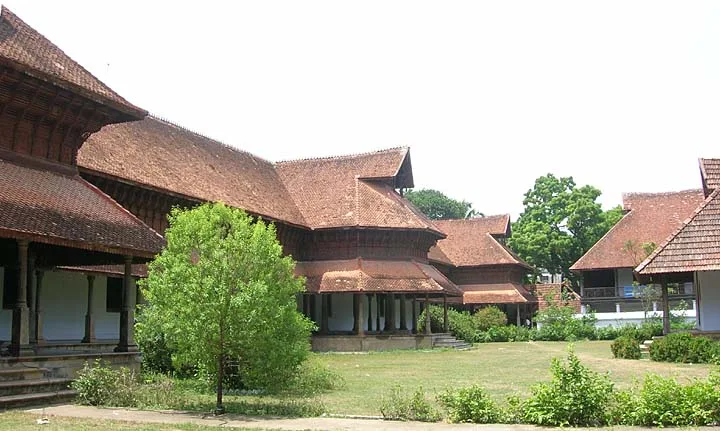
The temple fits easily into a walk of the Fort: Sree Padmanabhaswamy and its great tank, the Kuthiramalika palace museum, the Pazhavangadi Ganapathy temple and the old gates of the fort. The surrounding streets retain agraharam style rows of houses associated with the Tamil Brahmin community, where one may notice kolam patterns drawn at doorsteps in the morning, and small shops selling sweets and ritual goods.