A rare temple of Vishnu as the boar avatar with Lakshmi on his lap, beside a temple pond described as the largest in Kerala.
At a glance
What: A temple of Varaha, the third avatar of Vishnu, with the goddess Lakshmi.
Where: Sreevaraham, near Sree Padmanabhaswamy Temple.
When: Open daily; the main festival falls in the month of Meenam.
How: Reach from East Fort by autorickshaw or on foot.
By whom: Administered by the Travancore Devaswom Board.
For whom: Devotees and those interested in Kerala temple architecture.
About the temple
Temples to the boar form of Vishnu are uncommon, and only three are counted in Kerala. At Sreevaraham the god is shown seated, with Lakshmi resting on his lap, an affectionate pairing seen in very few shrines in India. Devotees therefore speak of him as Lakshmi Varaha and approach him for prosperity, stability and family happiness.
The architecture follows the Kerala manner. The sanctum is circular, covered by a conical roof sheathed in copper, and the surrounding nalambalam is square, a pleasing meeting of circle and square. A golden flagstaff stands before it. Ganapathi, Krishna, the serpent king and a yakshi are among the other deities. What many visitors remember longest is the pond, a broad sheet of water of about two and a half acres, described as the largest temple pond in the state, reflecting the roofs and sky.
History
No exact founding date is given in the sources used here. The temple belongs to the cluster of important shrines around the old fort that developed under the care of the rulers of Travancore, whose devotion to Vishnu shaped the city. Its present administration is by the devaswom board. The locality takes its name from the temple, an indication of how long it has been central to the neighbourhood.
The myth of the boar who raised the earth
The Puranas tell that the demon Hiranyaksha dragged the earth down into the cosmic waters. To rescue her, Vishnu took the form of an immense boar, plunged into the deep, fought the demon and lifted the earth on his tusks, restoring her to her place. The image has been carved across India for many centuries as a picture of protection and recovery. In art the earth goddess is often shown on the boar's arm or snout; here the emphasis falls instead on Lakshmi, seated in calm companionship after the struggle.
Teachers often use the story to speak about caring for the earth, and children readily remember the great boar rising from the waves.
Offerings and festivals
The offerings are those customary in Vishnu temples: personal prayers in the devotee's name, Ganapathi homam, the three sweets known as thrimadhuram, milk pudding, unniyappam and thulabharam, in which a person is weighed against an offering that is then given to the temple. The principal festival comes in the month of Meenam, between the middle of March and April, at the same season as the Painkuni festival of Padmanabhaswamy, so the whole area is festive. Varaha Jayanthi is also observed with grandeur.
Beliefs, claims and facts
Devotees believe that worship here helps with matters of land, house and settled life, a natural association with the god who recovered the earth. This is faith, and anyone with a property dispute should also take legal advice. The description of the pond as the largest in Kerala is the one commonly given; measurements of other temple tanks are quoted differently, so treat rankings with some care.
Reading the architecture
Kerala temples are designed for a land of heavy rain. Sloping roofs of copper or tile throw water well clear of the walls, and timber is protected under deep eaves. The round sanctum, called a vritta sreekovil, is a form especially associated with the southern half of the state, and its conical roof rises to a single finial. The square nalambalam around it creates a sheltered walk with lamps along its outer face, while a stone altar and smaller offering stones mark where food is presented to attendant deities.
Do not hurry past the outer wall and gateway. The sense of arrival, from the street to the compound, then to the covered enclosure and finally to the small doorway of the sanctum, is deliberate, drawing the mind inward step by step.
Water in temple life
A temple pond is more than decoration. Priests bathe in water set apart for them before beginning worship, devotees wash before entering, and the tank stores monsoon rain that helps to recharge wells in the surrounding houses. Neighbourhoods once organised themselves around such tanks, and conservationists point to them as a practical water system that modern cities neglect at their cost. A large pond also needs constant care to remove weeds and waste, and residents' cooperation matters.
Offerings explained
Thrimadhuram, the three sweets, is usually a mixture of honey or sugar, ghee and plantain offered to Vishnu. Paalpayasam is rice cooked slowly in milk and sugar until it turns a pale rose. Unniyappam are small round cakes of rice, jaggery and banana. In thulabharam the devotee sits on one side of a large balance while the other is loaded with the chosen item, commonly sugar, fruit or plantains, as thanks for an answered prayer.
Questions visitors ask
Why Lakshmi on the lap? The posture suggests that prosperity rests securely once the earth is protected, and it presents the fierce boar in a gentle, domestic mood. Is the pond open for swimming? Treat it as sacred water and follow posted rules. Can it be seen in the monsoon? Yes, and the full tank is beautiful, though paths are wet.
Visiting
Dress according to temple custom, with men bare above the waist inside and women in modest dress. Leave footwear at the entrance. Keep the pond clean, do not feed fish with processed food and do not bathe except where permitted. Steps by the water are slippery; hold children's hands. Photography within the temple is restricted, though views from outside the compound may be allowed.
Forty five minutes to an hour is enough. Evening, when lamps are lit and the water darkens, is especially peaceful. Check the midday closing hours.
Nearby
East Fort's temples, the palace museum, Attukal and Thiruvallam are all close. The beaches at Shanghumugham and Kovalam are within a short drive, and the temple fits well into a half day tour of the old city that includes breakfast at a traditional eating house and a walk through the Chalai bazaar.
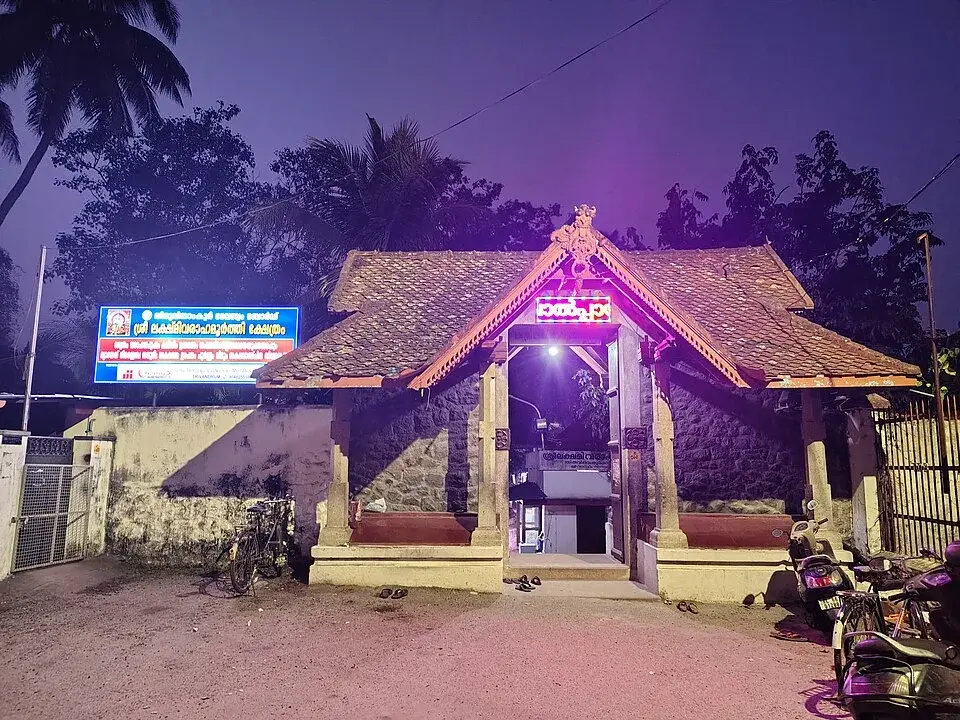 Photo: Manukrishnan80 · CC BY-SA 4.0