A forested catchment of the Karamana river, declared a sanctuary in 1983, with evergreen forest, rare swamps and high peaks.
At a glance
What: A protected forest around a drinking water reservoir.
Where: In the hills of eastern Thiruvananthapuram district.
When: Dam commissioned and sanctuary declared in 1983.
How: Travel by road via Nedumangad and Vithura, following forest rules.
By whom: Managed by the Kerala Forest and Wildlife Department.
For whom: Nature lovers, students and visitors who accept restrictions meant to protect wildlife and water.
About the sanctuary
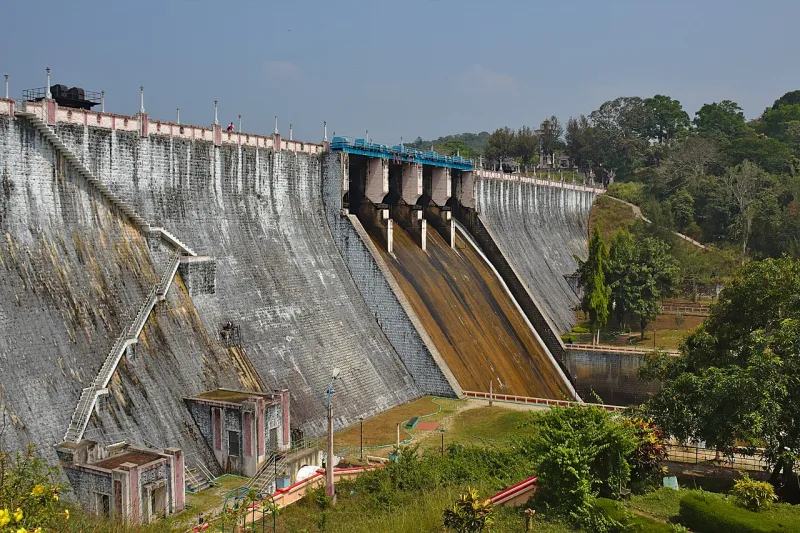
East of the capital the roads climb through rubber and pepper gardens until forest takes over. Here lies Peppara, a sanctuary made up of the catchment of the Karamana river, which rises at Chemmunjimottai, the highest hill within its limits. The name comes from the Peppara Dam, whose reservoir holds drinking water for Thiruvananthapuram city and its suburbs. Every glass of water from that supply is, in a sense, a product of these woods.
Published figures for the area differ: some give about 53 square kilometres, others about 75. The forests were formerly parts of the Palode and Kottoor reserves. The land is rugged, rising from about 100 metres to 1,717 metres. Besides Chemmunjimottai, the peaks include Athirumalai at 1,594 metres and Arumukhamkunnu at 1,457 metres. Average rainfall is around 2,500 millimetres a year.
History
The dam was commissioned in 1983 to strengthen the city's water supply, supporting the older headworks downstream at Aruvikkara. In the same year, recognising the ecological value of the surrounding slopes, the government declared the area a wildlife sanctuary. Protecting the forest and protecting the reservoir are one task: tree cover slows the rush of monsoon water, holds soil in place and keeps streams flowing into the dry months. The sanctuary belongs to the larger Agasthyamala Biosphere Reserve, spread across the southern Western Ghats of Kerala and Tamil Nadu, one of the richest regions of plant life in India and part of a mountain chain recognised internationally for its biological diversity.
The forests
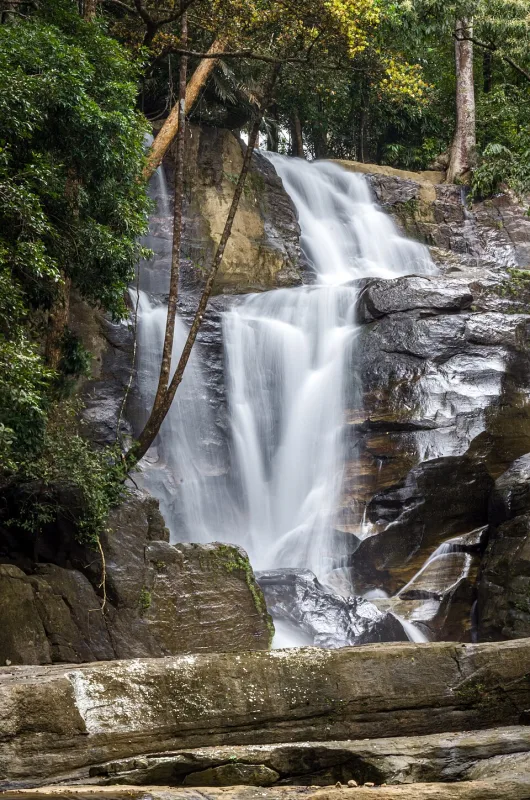
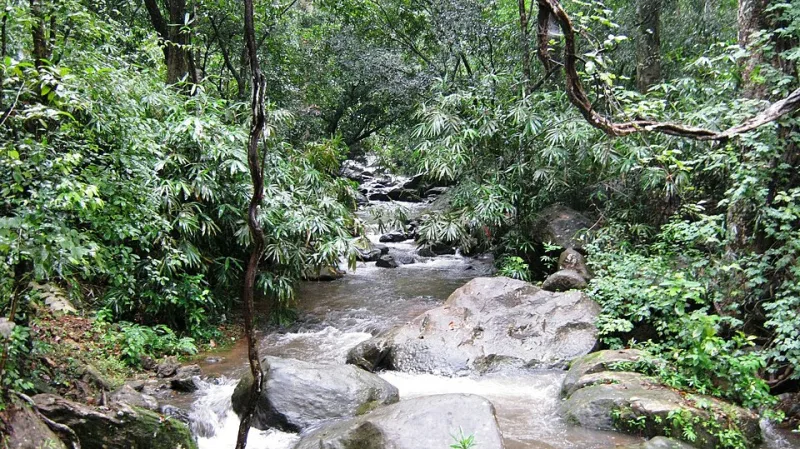
Several types of vegetation occur: tropical evergreen and semi evergreen forest, moist deciduous forest, stunted hilltop evergreen and low mountain swamp forest. Of special interest are the Myristica swamps, waterlogged forest dominated by relatives of the nutmeg tree, whose roots loop out of the mud to breathe. Such swamps are rare, ancient habitats that survive only in a few places along the Western Ghats and shelter specialised creatures. Common trees include Terminalia, Pterocarpus, Mesua, Hopea, silk cotton, jamun and Alstonia.
The sanctuary supports a range of mammals, with more than forty species reported, together with birds, reptiles, amphibians, fishes and insects. Seeing large animals is a matter of luck. Frog calls after rain, the flash of a bird and the track of a deer in soft ground are the more usual rewards.
People of the forest
The southern forests are home to Kani families, an indigenous community with deep knowledge of plants and paths. Their relationship with the land predates the sanctuary. Visitors should treat settlements as homes, never as exhibits, and should not enter or photograph without consent and official permission.
Legends of the hills
The whole mountain region takes its identity from the sage Agastya, who in southern tradition was sent by Shiva to balance the earth when it tilted under the weight of those gathered in the north, and who is revered as a teacher of Tamil grammar and of medicine. The peak called Agasthyarkoodam, in the same biosphere reserve, is the focus of pilgrimage. Healers speak of the herbs of these slopes as the sage's pharmacy. The legend belongs to devotion; the abundance of medicinal plants is observable fact.
Rumours and realities
Travel posts sometimes show Peppara as an open picnic ground with boating and trekking available on arrival. Entry to a sanctuary is controlled, activities depend on current permission and some areas are closed altogether, particularly in fire season or heavy rain. Stories of easy forest shortcuts are dangerous. Elephants and other animals move through the region, and leeches are plentiful in wet months.
A year in the catchment
The seasons give the forest very different faces. From June the southwest monsoon pours onto the slopes, streams roar, cloud sits on the peaks and new growth appears everywhere. A second spell of rain arrives with the northeast monsoon in October and November. By the cool months the water is clearer and the reservoir broad. From February the deciduous patches shed leaves, the undergrowth dries and fire becomes the chief worry of forest staff, who cut protective lines and keep watch. Animals gather closer to water in these weeks, and for their sake as much as for yours, the department may restrict movement.
Learning to look
A forest rewards patience. Walk slowly, if a walk is permitted, and stop often. Listen for the layers of sound: insects, a barbet calling monotonously, the whistle of a thrush near a stream, the crash of monkeys in the canopy. Look at fallen fruit, fungi on rotting logs and the tall straight trunks supported by flared bases. A guide from the forest department or a trained local escort can read signs that a newcomer would walk past. Binoculars are more useful than a large camera.
Visiting
Contact the wildlife warden's office or the Forest Department in Thiruvananthapuram before setting out, and ask what is open. Carry identity documents. Wear full sleeves, sturdy shoes and subdued colours. Take drinking water and bring back every bit of waste. Do not play music, light fires, collect plants, feed animals or swim in the reservoir. Photography at dam structures may be restricted.
Half a day is a sensible allowance including the drive.
Questions visitors ask
Is the monsoon a good time? The forest is magnificent but access is often curtailed and slopes are unsafe. Is accommodation available inside? Do not assume so; check official eco tourism listings. Are children welcome? Yes where activities are permitted, with close supervision. Is there mobile coverage? It may be poor, so tell someone your plans.
Why a quiet forest matters
A sanctuary is not mainly a show for visitors. Its success is measured by clean water, regenerating trees and animals that can live without disturbance. A trip that sees little but leaves nothing behind has still been a good one.
Nearby
The Peppara visit combines naturally with the Ponmudi hill station, the Golden Valley stream area at Kallar, the Aruvikkara dam, Koyikkal Palace at Nedumangad and the botanic garden at Palode, though each deserves unhurried time and has its own opening rules.
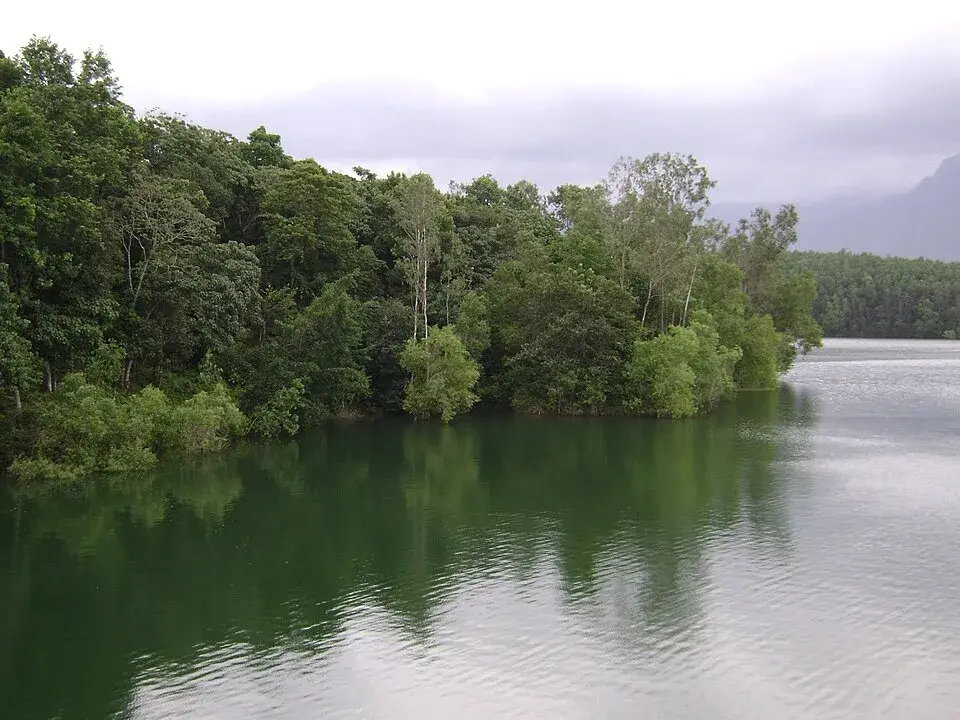 Photo: Shadow auror at English Wikipedia - Rajiv R Nair · CC BY-SA 3.0